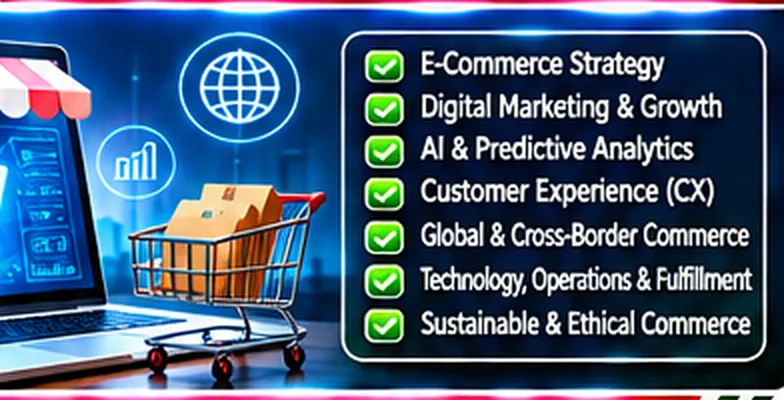
The AC-ESGP® curriculum progresses from e-commerce strategy and business modeling through digital marketing, customer analytics, AI integration, operational management, global expansion, and strategic growth leadership.
Each module includes three comprehensive submodules, practical applications, and an applied learning activity.
Module 1: E-Commerce Strategy, Business Models, and Digital Market Intelligence
Module Objective: Develop the ability to evaluate digital commerce environments, select appropriate business models, and formulate competitive e-commerce strategies.
1.1 Foundations of Modern E-Commerce and Digital Business Models
Examine the structure, evolution, and commercial characteristics of modern e-commerce.
Key Topics:
- Business-to-consumer (B2C) commerce.
- Business-to-business (B2B) commerce.
- Direct-to-consumer (DTC) models.
- Online marketplaces.
- Subscription commerce.
- Social commerce.
- Omnichannel retailing.
- Platform-based business models.
- Digital revenue streams.
- E-commerce operating structures.
Practical Application: Compare three e-commerce business models and evaluate their suitability for a selected organization.
1.2 Digital Market Research and Competitive Intelligence
Explore methods for identifying market opportunities, analyzing competitors, and understanding digital consumer demand.
Key Topics:
- Digital market segmentation.
- Customer needs analysis.
- Competitive benchmarking.
- Online consumer behavior.
- Market sizing and opportunity assessment.
- Digital competitor analysis.
- Search demand and customer interest.
- Industry trends.
- Customer value propositions.
- Competitive differentiation.
Practical Application: Prepare a digital market opportunity assessment for an online business.
1.3 Strategic E-Commerce Planning and Business Growth Architecture
Develop structured strategies connecting commercial objectives, technology, marketing, operations, and financial performance.
Key Topics:
- E-commerce vision and mission.
- Strategic objectives.
- Business growth planning.
- Revenue models.
- Customer value propositions.
- Digital channel selection.
- Resource allocation.
- Strategic risk assessment.
- Growth performance indicators.
- Implementation roadmaps.
Practical Application: Develop an e-commerce business strategy for a new or existing digital commerce organization.
Module Deliverable: E-Commerce Market Intelligence and Strategic Business Plan.
Module 2: Digital Marketing, Customer Acquisition, and Revenue Growth
Module Objective: Develop integrated digital marketing and customer acquisition strategies that support profitable and sustainable e-commerce growth.
2.1 Search Marketing, Content Strategy, and Digital Visibility
Examine how organizations attract potential customers through search engines, content, and digital discovery channels.
Key Topics:
- Search engine optimization (SEO).
- Search engine marketing.
- Paid search advertising.
- Keyword research.
- Content marketing.
- Product page optimization.
- Organic traffic development.
- Digital brand positioning.
- Marketing attribution.
- Search performance indicators.
Practical Application: Develop a digital visibility and customer acquisition plan for an e-commerce product category.
2.2 Social Commerce, Paid Advertising, and Growth Campaigns
Explore the role of social platforms, advertising campaigns, and digital customer engagement in business growth.
Key Topics:
- Social commerce strategies.
- Paid social advertising.
- Influencer marketing evaluation.
- Campaign targeting.
- Creative testing.
- Advertising budgets.
- Audience segmentation.
- Campaign performance analysis.
- Return on advertising spend.
- Marketing experimentation.
Practical Application: Design an integrated digital marketing campaign with budget assumptions and performance measures.
2.3 Customer Acquisition Economics and Revenue Optimization
Develop the ability to evaluate the financial effectiveness of customer acquisition and digital marketing investments.
Key Topics:
- Customer acquisition cost (CAC).
- Customer lifetime value (CLV).
- Customer acquisition payback.
- Average order value (AOV).
- Revenue per visitor.
- Marketing contribution margin.
- Customer conversion costs.
- Acquisition channel performance.
- Campaign profitability.
- Growth investment decisions.
Practical Application: Evaluate customer acquisition performance and recommend a more efficient marketing investment strategy.
Module Deliverable: Digital Customer Acquisition and Revenue Growth Plan.
Module 3: Customer Experience, Conversion Optimization, and Retention Strategy
Module Objective: Develop customer-focused strategies that improve digital purchasing experiences, conversion performance, customer satisfaction, and long-term retention.
3.1 Digital Customer Journey and User Experience Design
Explore the relationship between website design, usability, customer expectations, and purchasing decisions.
Key Topics:
- Customer journey mapping.
- User experience fundamentals.
- Mobile commerce usability.
- Product discovery.
- Product information quality.
- Accessibility considerations.
- Shopping cart experience.
- Checkout friction.
- Customer trust signals.
Practical Application: Evaluate an e-commerce customer journey and identify major usability barriers.
3.2 Conversion Rate Optimization and Digital Experimentation
Develop systematic methods for improving the percentage of visitors who complete desired actions.
Key Topics:
- Conversion rate analysis.
- Conversion funnel diagnostics.
- Cart abandonment.
- Checkout optimization.
- Landing page effectiveness.
- A/B testing.
- Hypothesis development.
- Experiment measurement.
- Statistical interpretation.
- Conversion improvement planning.
Practical Application: Develop a conversion rate optimization experiment for a product or checkout page.
3.3 Customer Retention, Loyalty, and Lifecycle Marketing
Examine strategies for maintaining customer relationships and encouraging repeat purchasing.
Key Topics:
- Customer relationship management.
- Customer segmentation.
- Email lifecycle marketing.
- Customer loyalty programs.
- Repeat purchase behavior.
- Retention analytics.
- Customer service performance.
- Customer feedback analysis.
- Personalization.
- Customer lifetime value improvement.
Practical Application: Develop a customer retention and lifecycle engagement strategy.
Module Deliverable: Customer Experience and Conversion Optimization Framework.
Module 4: Artificial Intelligence, Predictive Analytics, and Intelligent E-Commerce
Module Objective: Develop practical knowledge of AI technologies and their applications in digital commerce strategy, customer engagement, marketing, and business operations.
4.1 Artificial Intelligence and Machine Learning in E-Commerce
Explore AI concepts and applications supporting commercial intelligence and digital operations.
Key Topics:
- Artificial intelligence fundamentals.
- Machine learning concepts.
- Predictive analytics.
- AI-powered product recommendations.
- Customer segmentation models.
- Demand forecasting.
- Intelligent pricing applications.
- AI-supported product discovery.
- Customer behavior analytics.
- Model reliability and limitations.
Practical Application: Evaluate AI applications for improving online product discovery and customer engagement.
4.2 Generative AI and Intelligent Customer Engagement
Examine how generative AI can support e-commerce content development, customer service, and marketing workflows.
Key Topics:
- Generative AI applications.
- AI-assisted product descriptions.
- Marketing content development.
- AI-powered customer support.
- Conversational commerce.
- Chatbots and virtual assistants.
- AI-assisted campaign planning.
- Content quality assurance.
- Customer information protection.
- Human oversight.
Practical Application: Develop a controlled generative AI workflow for product content or customer service.
4.3 Predictive Commerce and Intelligent Business Automation
Explore AI-supported approaches to forecasting, personalization, operational efficiency, and commercial decision-making.
Key Topics:
- Predictive customer analytics.
- Customer churn indicators.
- Demand forecasting.
- Product recommendation logic.
- Marketing automation.
- Intelligent inventory signals.
- Dynamic pricing considerations.
- Automated customer engagement.
- Performance monitoring.
- Responsible AI governance.
Practical Application: Develop an AI-enabled e-commerce improvement proposal with measurable business objectives.
Module Deliverable: AI-Enabled E-Commerce Innovation and Automation Strategy.
Module 5: E-Commerce Platforms, Digital Payments, and Technology Infrastructure
Module Objective: Develop the ability to evaluate digital commerce platforms, payment technologies, enterprise integrations, and technology security requirements.
5.1 E-Commerce Platform Architecture and Technology Selection
Examine the technologies supporting modern online commerce.
Key Topics:
- Hosted e-commerce platforms.
- Enterprise commerce systems.
- Marketplace technologies.
- Content management systems.
- Product information management.
- Headless commerce concepts.
- Mobile commerce architecture.
- Platform scalability.
- Technology vendor evaluation.
- Build-versus-buy considerations.
Practical Application: Compare e-commerce platform options using business, technical, and financial criteria.
5.2 Digital Payments and Transaction Management
Explore the payment technologies and operational controls supporting secure online transactions.
Key Topics:
- Payment gateways.
- Payment service providers.
- Credit and debit card transactions.
- Digital wallets.
- Alternative payment methods.
- Payment authorization and settlement.
- Refund processing.
- Chargebacks.
- Transaction reconciliation.
- Payment fraud prevention.
Practical Application: Map an e-commerce payment workflow and identify transaction risks.
5.3 Cybersecurity, Privacy, and Enterprise Integration
Evaluate the security, governance, and integration requirements of e-commerce operations.
Key Topics:
- Customer data protection.
- Account security.
- Access management.
- Encryption concepts.
- Payment card security requirements.
- Fraud monitoring.
- API integration.
- ERP connectivity.
- Inventory and order management integration.
- Technology resilience.
Practical Application: Develop an e-commerce technology risk and integration checklist.
Module Deliverable: E-Commerce Technology and Digital Payment Infrastructure Assessment.
Module 6: E-Commerce Supply Chain, Inventory, Fulfillment, and Operations
Module Objective: Develop an integrated understanding of how digital sales performance depends on reliable inventory, supplier coordination, order processing, logistics, and customer fulfillment.
6.1 E-Commerce Supply Chain and Inventory Intelligence
Explore the relationship between online demand, inventory availability, supplier performance, and operational planning.
Key Topics:
- Digital demand planning.
- Inventory visibility.
- Supplier coordination.
- Stock availability.
- Safety stock considerations.
- Replenishment planning.
- Inventory turnover.
- Stockout prevention.
- Demand forecasting.
- Inventory performance indicators.
Practical Application: Evaluate inventory availability and purchasing requirements for a growing online retailer.
6.2 Order Fulfillment, Logistics, and Last-Mile Delivery
Examine the operational processes required to deliver online orders efficiently.
Key Topics:
- Order management systems.
- Warehouse operations.
- Fulfillment models.
- Third-party logistics.
- Shipping and carrier selection.
- Delivery performance.
- Last-mile logistics.
- Fulfillment costs.
- Delivery tracking.
- Customer communication.
Practical Application: Develop an e-commerce fulfillment strategy comparing internal and outsourced logistics options.
6.3 Returns Management and Operational Performance
Explore reverse logistics, returns policies, customer service, and operational efficiency.
Key Topics:
- Product returns.
- Reverse logistics.
- Refund and exchange workflows.
- Return fraud considerations.
- Customer service integration.
- Returns cost analysis.
- Operational performance dashboards.
- Fulfillment quality.
- Sustainable packaging.
- Continuous improvement.
Practical Application: Develop an e-commerce returns and operational performance improvement plan.
Module Deliverable: Integrated E-Commerce Fulfillment and Operations Strategy.
Module 7: Global E-Commerce Expansion, Compliance, and Sustainable Commerce
Module Objective: Develop strategies for entering international digital markets while managing cross-border operations, compliance obligations, customer expectations, and sustainability considerations.
7.1 International E-Commerce Market Entry and Localization
Explore the strategic and operational requirements of cross-border digital commerce.
Key Topics:
- International market assessment.
- Country selection.
- Customer behavior differences.
- Cultural adaptation.
- Website localization.
- Multilingual commerce.
- Currency considerations.
- Regional payment preferences.
- International customer service.
- Market entry strategies.
Practical Application: Develop a market entry plan for an e-commerce business expanding into a selected international market.
7.2 Cross-Border Payments, Trade Compliance, and Consumer Protection
Examine the compliance considerations associated with international digital transactions.
Key Topics:
- International payment processing.
- Customs and import requirements.
- Duties and taxes.
- Sales tax and VAT considerations.
- Consumer protection obligations.
- Product restrictions.
- Privacy requirements.
- Cross-border returns.
- Digital transaction documentation.
- International fulfillment risks.
Practical Application: Prepare a cross-border commerce compliance and operational risk checklist.
7.3 Ethical, Sustainable, and Responsible E-Commerce
Explore responsible business practices supporting long-term commercial performance.
Key Topics:
- Ethical digital marketing.
- Transparent product information.
- Responsible customer data use.
- Sustainable packaging.
- Carbon-conscious fulfillment.
- Responsible supplier selection.
- Waste reduction.
- Returns sustainability.
- Responsible AI.
- Sustainability performance indicators.
Practical Application: Develop a sustainable and responsible e-commerce improvement framework.
Module Deliverable: Global E-Commerce Expansion and Responsible Commerce Strategy.
Module 8: E-Commerce Growth Leadership, Financial Performance, and Strategic Transformation
Module Objective: Integrate business strategy, marketing, customer analytics, technology, operations, and financial management into a comprehensive e-commerce growth plan.
8.1 E-Commerce Financial Performance and Growth Analytics
Develop the ability to evaluate financial and operational performance using appropriate commercial indicators.
Key Topics:
- Revenue growth analysis.
- Gross margin.
- Contribution margin.
- Customer acquisition cost.
- Customer lifetime value.
- Average order value.
- Conversion rate.
- Retention rate.
- Inventory performance.
- Marketing return on investment.
- Cash flow considerations.
- Growth profitability.
Practical Application: Develop an executive e-commerce performance dashboard.
8.2 Digital Business Scaling and Strategic Growth Management
Explore how organizations can expand digital operations while managing financial, technological, and operational constraints.
Key Topics:
- Growth strategy execution.
- Market expansion.
- Customer acquisition scaling.
- Technology capacity.
- Operational scalability.
- Workforce requirements.
- Strategic partnerships.
- Risk management.
- Investment prioritization.
- Performance governance.
Practical Application: Evaluate a digital commerce expansion proposal and identify major growth constraints.
8.3 Integrated E-Commerce Strategy and Growth Project
Develop a comprehensive growth strategy integrating the program's core competencies.
Project Components:
- Digital market assessment.
- Business model evaluation.
- Customer acquisition strategy.
- Customer experience improvement.
- AI technology integration.
- Commerce platform assessment.
- Fulfillment strategy.
- Financial performance measures.
- Risk and compliance considerations.
- Implementation roadmap.
Practical Application: Present a complete e-commerce growth strategy to a simulated management team.
Module Deliverable: Final E-Commerce Strategy and Growth Implementation Plan.