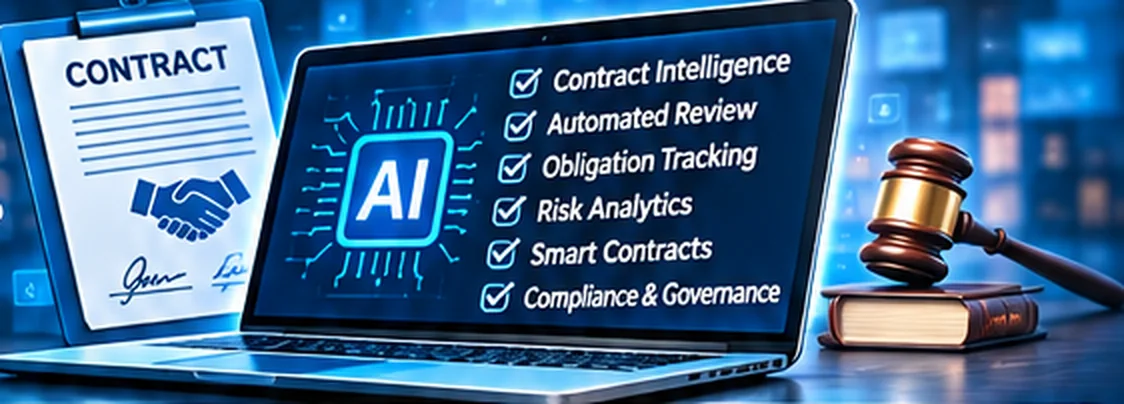
Transform Contract Management. Automate Workflows. Strengthen Compliance. Lead with Artificial Intelligence.

1. Program Overview

The Executive Diploma in AI-Integrated Contract Management & Automation (ED-CMAAI)® is an advanced, practitioner-focused program designed to equip contract, procurement, legal, and compliance leaders with the strategic knowledge and practical skills to manage the full contract lifecycle using AI, automation, NLP, and blockchain technologies.

  • Modernize contract processes from creation to closeout with AI-enabled CLM and intelligent automation.
  • Use NLP to extract, classify, and analyze contract clauses with speed and accuracy.
  • Implement automated workflows for approvals, obligations, renewals, and compliance.
  • Identify and mitigate contractual risks using predictive analytics and risk-scoring models.
  • Strengthen governance, audit readiness, and supplier performance through digital contract intelligence.

Program at a Glance

Program TitleExecutive Diploma in AI-Integrated Contract Management & Automation (ED-CMAAI)®
DesignationED-CMAAI®
Awarding OrganizationAAPSCM®
Program LevelAdvanced Executive Diploma
Curriculum8 Comprehensive Modules
Learning ApproachExecutive lectures, case studies, hands-on exercises, AI demonstrations, and a capstone project
Virtual Instructor-Led Training5 days, 2 hours daily (10 hours total)
Self-Paced LearningFlexible independent study with complimentary materials
In-Seat Executive Training4 days, scheduled cohort-based instruction
In-Seat LocationAAPSCM® Training Center, Dallas, Texas, USA
AssessmentMandatory Executive Capstone Project (Pass ≥ 70%)
Virtual Training Fee$2,500 USD
Self-Paced Fee$800 USD
In-Seat Training Fee$3,000 USD
International ParticipationInternational applicants are welcome

2. Why This Executive Diploma MattersKey Reasons to Advance Your Contract Management with AI

Modernize Contract Operations

Move from manual, document-centric processes to an AI-enabled, end-to-end contract lifecycle.

AI-Driven Contract Intelligence

Extract, analyze, and interpret contract clauses with NLP for faster, more accurate reviews.

Reduce Contract Risks

Identify high-risk clauses, compliance gaps, and potential disputes before they escalate.

Automate Workflows & Obligations

Streamline contract creation, approvals, tracking, and renewals with intelligent automation.

Ensure Compliance & Governance

Align contracting practices with legal, regulatory, and ISO standards (ISO 9001, 27001, 37301, 28000, 42001).

Lead Digital Transformation

Build a strategic CLM roadmap, drive adoption, and deliver measurable business value.

1 / 6Swipe or use the arrows →

Program Video

3. Program Learning Outcomes

By the end of the program, you will be able to:

  • Use AI and NLP to extract, classify, and analyze contract clauses.
  • Automate contract workflows, approvals, and obligation tracking.
  • Apply predictive analytics to assess contract risk and supplier performance.
  • Implement blockchain and smart contracts for secure, transparent transactions.
  • Establish contract governance, legal compliance, and audit controls.
  • Design executive dashboards for contract risk, compliance, and performance.
  • Lead CLM digital transformation initiatives across the enterprise.
  • Deliver measurable efficiencies, risk reduction, and contract value.

4. Program Curriculum – 8 Comprehensive ModulesA Practical, Strategic, and AI-Focused Executive Curriculum

Module 1Foundations of AI Contract Analytics & NLP
Module 2AI-Enabled Contract Creation, Redlining & Review
Module 3Contract Lifecycle Automation & Obligations Management
Module 4Smart Contracts, Blockchain & Digital Authentication
Module 5Predictive Contract Risk Scoring & Performance Dashboards
Module 6Contract Intelligence Automation Lab
Module 7Governance, Legal Compliance & Responsible AI
Module 8Digital Contract Transformation & Change Management
1 / 8Swipe or use the arrows →

5. Knowledge DomainCore Competencies You Will Gain

Contract Intelligence & NLP
Lifecycle Automation & CLM
Risk Analytics & Performance
Compliance & Governance
Blockchain & Smart Contracts
Digital Transformation & Leadership
1 / 6Swipe or use the arrows →

6. Global Standards & Frameworks

ISO 9001Quality Management
ISO 27001Information Security
ISO 37301Compliance Management
ISO 28000Supply Chain Security
ISO/IEC 42001AI Management Systems
Contracting & LegalBest Practices (IACCM/WorldCC)
1 / 6Swipe or use the arrows →
Strengthen Contract Governance
Reduce Risk & Compliance Costs
Improve Supplier Performance
Drive Digital Contract Transformation

More about ED-CMAAI® Executive Diploma

The complete program information, in one place. Swipe sideways or use the arrows to browse each topic.

1
Program Overview

The Executive Diploma in AI-Integrated Contract Management & Automation (ED-CMAAI)® is an advanced, practitioner-focused executive education program designed to equip procurement executives, contract managers, legal operations professionals, compliance specialists, project managers, and digital transformation leaders with the strategic, technical, and managerial competencies required to modernize contract management using artificial intelligence (AI), intelligent automation, natural language processing (NLP), predictive analytics, and emerging digital technologies.

Modern organizations manage increasingly complex contractual relationships involving suppliers, customers, contractors, service providers, technology vendors, strategic partners, and regulatory authorities. These relationships generate substantial volumes of contracts, amendments, service-level agreements, procurement documents, confidentiality agreements, and compliance records.

Traditional contract management processes frequently depend on manual document review, email-based approvals, disconnected spreadsheets, fragmented contract repositories, and reactive monitoring of contractual obligations. Such practices can contribute to delayed negotiations, missed renewal dates, inconsistent contract terms, financial exposure, compliance failures, and limited visibility into contractual performance.

AI-enabled Contract Lifecycle Management (CLM) technologies offer opportunities to transform these processes through automated document classification, intelligent clause extraction, contract comparison, risk identification, obligation monitoring, workflow automation, and data-driven reporting.

However, effective contract automation requires more than introducing AI software. Organizations must establish reliable contract data, standardized governance procedures, appropriate legal oversight, secure information management, accountable decision-making, and measurable implementation objectives.

The ED-CMAAI® program addresses these requirements through an integrated executive curriculum covering contract intelligence, AI-assisted drafting and review, lifecycle automation, obligation management, blockchain applications, predictive risk analytics, legal compliance, responsible AI governance, and organizational transformation.

Participants learn how to evaluate contract management maturity, identify automation opportunities, design AI-supported review workflows, develop contract risk-scoring methodologies, establish performance dashboards, and prepare practical implementation roadmaps.

The program emphasizes executive decision-making, applied business scenarios, contract analysis exercises, technology demonstrations, and a mandatory capstone project.

Its primary objective is to prepare professionals to transition from traditional, document-centered contract administration toward intelligent, proactive, compliant, secure, and strategically integrated contract lifecycle management.

Program at a Glance

Program ComponentDetails
Program TitleExecutive Diploma in AI-Integrated Contract Management & Automation
DesignationED-CMAAI®
Awarding OrganizationAAPSCM®
Program LevelAdvanced Executive Diploma
Curriculum8 comprehensive executive modules
Learning ApproachExecutive instruction, AI demonstrations, case studies, contract analysis exercises, workflow simulations, and capstone development
Virtual Instructor-Led Training5 days, 2 hours daily
Total Virtual Instruction10 hours
Self-Paced LearningFlexible independent study with complete complimentary course materials
In-Seat Executive Training4 days, scheduled cohort-based instruction
In-Seat LocationAAPSCM® Training Center, Dallas, Texas, USA
Final AssessmentMandatory Applied Executive Capstone Project
Minimum Capstone Passing Score70%
Virtual Training Fee$2,500 USD
Self-Paced Fee$800 USD
In-Seat Training Fee$3,000 USD
International ParticipationInternational applicants welcome
Professional FocusAI contract intelligence, CLM, automation, compliance, risk analytics, blockchain, and executive leadership
2
Why This Executive Diploma Matters

Contract management is increasingly recognized as a strategic business function influencing organizational performance, financial outcomes, legal compliance, supplier relationships, and enterprise risk management.

2.1 The Evolution of Contract Management

Traditional contract administration emphasizes document preparation, signature collection, filing, and periodic review.

Modern CLM requires organizations to manage the entire contractual relationship, from initial request and drafting through negotiation, approval, execution, performance monitoring, amendment, renewal, and termination.

The program examines how integrated CLM processes improve contractual visibility, accountability, and coordination.

2.2 Increasing Contract Complexity

Organizations frequently manage contracts involving multiple jurisdictions, regulatory obligations, performance requirements, commercial terms, and stakeholders.

Manual review processes can become difficult to scale as contract volumes increase.

AI-assisted document analysis and structured contract repositories can help professionals identify relevant information more efficiently while preserving legal review and accountability.

2.3 From Manual Review to AI-Enabled Contract Intelligence

AI and NLP can assist with extracting contract clauses, identifying missing provisions, comparing document versions, and flagging potentially unusual language.

Participants learn how these capabilities work, their limitations, and how to design human validation procedures.

2.4 Reducing Contractual Risk and Financial Exposure

Contracts may contain unfavorable payment provisions, ambiguous deliverables, inappropriate liability allocations, missing protections, and poorly defined termination conditions.

The program introduces risk classification, contract scoring, exception monitoring, and escalation frameworks to support more consistent contractual decision-making.

2.5 Strengthening Compliance and Audit Readiness

Organizations must manage contractual commitments alongside applicable legal obligations, internal policies, data protection requirements, and supplier governance standards.

The program demonstrates how automated obligation tracking, compliance dashboards, and controlled audit trails can strengthen monitoring and accountability.

2.6 Improving Operational Efficiency Through Automation

Contract processes may involve repetitive administrative tasks, including document routing, approval reminders, metadata entry, status reporting, and renewal notifications.

Intelligent automation can reduce administrative effort and allow professionals to concentrate on negotiation, supplier performance, legal analysis, and strategic decisions.

2.7 Supporting Digital Procurement Transformation

Contract management does not operate independently of procurement, finance, enterprise resource planning, supplier management, and project delivery systems.

The program examines how CLM solutions can be integrated into wider enterprise processes to improve data consistency and organizational coordination.

2.8 Building Future-Ready Contract Management Leadership

Successful AI adoption requires leadership, process redesign, stakeholder engagement, workforce development, information security, and measurable business objectives.

Participants learn to evaluate transformation opportunities and communicate implementation recommendations to executive stakeholders.

3
Target Audience: Who Should Enroll?

The ED-CMAAI® program is designed for experienced professionals, functional managers, senior executives, consultants, and emerging leaders involved in contract management, procurement, legal operations, governance, and business transformation.

Procurement and Contract Management Professionals

  • Chief Procurement Officers
  • Procurement Directors and Managers
  • Contract Management Directors
  • Contract Lifecycle Management Specialists
  • Strategic Sourcing Managers
  • Category Management Professionals
  • Procurement Operations Managers
  • Commercial Contract Managers
  • Vendor and Supplier Relationship Managers
  • Contract Administrators and Analysts

Legal, Compliance, and Governance Professionals

  • Legal Operations Directors
  • Corporate Legal Professionals
  • In-House Counsel
  • Contract Compliance Managers
  • Regulatory Compliance Officers
  • Corporate Governance Specialists
  • Internal Audit Professionals
  • Enterprise Risk Managers
  • Data Protection and Information Governance Professionals

Project and Commercial Management Professionals

  • Project Directors and Project Managers
  • Commercial Operations Managers
  • Construction Contract Managers
  • Engineering Procurement and Construction Professionals
  • Contract Performance Managers
  • Service-Level Agreement Managers
  • Business Operations Directors

Technology and Digital Transformation Professionals

  • AI Transformation Managers
  • Digital Procurement Specialists
  • Business Process Automation Managers
  • Enterprise Systems Professionals
  • Contract Technology Consultants
  • Business Intelligence Analysts
  • CLM System Administrators
  • Robotic Process Automation Specialists
  • Information Systems Managers

Public-Sector and Institutional Professionals

  • Government Procurement Officers
  • Public Contracting Managers
  • Public-Sector Compliance Specialists
  • Institutional Contract Administrators
  • Public Procurement Auditors
  • Government Digital Transformation Professionals

The program is also suitable for consultants and professionals preparing for broader leadership responsibilities in enterprise contract management, procurement automation, and digital governance.

4
Program Learning Outcomes

Upon successful completion of the ED-CMAAI® program, participants should be able to demonstrate the following competencies.

A. AI Contract Intelligence and Natural Language Processing

  • Explain the principles of AI-enabled contract intelligence and NLP.
  • Identify common contract structures, clauses, metadata, and legal provisions.
  • Evaluate AI-assisted clause extraction and document classification.
  • Analyze automated contract comparison and redlining capabilities.
  • Develop structured contract clause libraries.
  • Identify limitations, inaccuracies, and risks associated with AI-generated contract analysis.

B. Contract Creation, Review, and Negotiation

  • Design standardized contract drafting and review workflows.
  • Evaluate AI-supported contract drafting tools.
  • Identify missing, inconsistent, or potentially unfavorable contract provisions.
  • Develop contract approval and escalation procedures.
  • Integrate legal review and human oversight into automated contracting processes.
  • Recommend controls for contract version management and document integrity.

C. Contract Lifecycle Automation

  • Explain the major stages of the contract lifecycle.
  • Identify opportunities for workflow automation.
  • Develop automated obligation-tracking procedures.
  • Design renewal, expiration, and compliance alert systems.
  • Evaluate CLM integration with procurement and enterprise systems.
  • Recommend performance measures for contract workflow efficiency.

D. Predictive Contract Risk and Performance Analytics

  • Classify contractual financial, operational, legal, cybersecurity, and compliance risks.
  • Develop contract risk-scoring methodologies.
  • Explain predictive analytics applications in contract management.
  • Design contract performance dashboards.
  • Interpret risk alerts, exception reports, and contract performance indicators.
  • Recommend risk mitigation and corrective action strategies.

E. Blockchain and Digital Contracting

  • Explain blockchain and distributed ledger concepts.
  • Evaluate smart contract applications in procurement.
  • Distinguish automated contract execution from legal enforceability.
  • Assess digital signature and electronic authentication requirements.
  • Identify blockchain implementation limitations and security concerns.

F. Governance, Compliance, and Responsible AI

  • Apply risk-based contract governance principles.
  • Explain relevant information security and compliance management standards.
  • Identify data privacy, confidentiality, and intellectual property concerns.
  • Evaluate responsible AI requirements for contract analysis.
  • Develop appropriate human oversight and accountability mechanisms.
  • Recommend contract audit and evidence-retention controls.

G. Executive Transformation and Leadership

  • Assess organizational contract management maturity.
  • Develop an AI-enabled CLM transformation strategy.
  • Evaluate implementation costs, benefits, and operational risks.
  • Develop stakeholder engagement and change management plans.
  • Establish measurable performance indicators.
  • Present executive recommendations for digital contract transformation.
5
Comprehensive Executive Diploma Curriculum

8 Executive Modules | Practical Contract Intelligence Exercises | Applied Case Studies | Mandatory Executive Capstone

6
Explore the Eight Modules

Scroll horizontally

MODULE 01

Foundations of AI Contract Analytics & NLP

AI contract intelligence, NLP, clause extraction, document classification, contract data, and clause libraries.

MODULE 02

AI-Enabled Contract Creation, Redlining & Review

AI-assisted drafting, contract comparison, redlining, negotiation support, and approval workflows.

MODULE 03

Contract Lifecycle Automation & Obligations Management

CLM workflows, obligation tracking, renewal alerts, RPA, and enterprise system integration.

MODULE 04

Smart Contracts, Blockchain & Digital Authentication

Blockchain fundamentals, smart contract design, digital signatures, audit trails, and procurement applications.

MODULE 05

Predictive Contract Risk Scoring & Performance Dashboards

Contract risk models, performance indicators, risk heat maps, predictive alerts, and executive reporting.

MODULE 06

Contract Intelligence Automation Lab

Applied contract extraction, clause analysis, redlining simulation, workflow automation, and dashboard development.

MODULE 07

Governance, Legal Compliance & Responsible AI

Contract governance, compliance management, information security, legal oversight, and ethical AI.

MODULE 08

Digital Contract Transformation & Change Management

CLM implementation, organizational readiness, stakeholder engagement, transformation leadership, and continuous improvement.

Module 1: Foundations of AI Contract Analytics & Natural Language Processing

Module Objective: Establish a comprehensive understanding of contract lifecycle management, AI contract intelligence, NLP, contract data structures, and intelligent document analysis.

Core Topics

  • Evolution of traditional contract administration
  • Introduction to modern Contract Lifecycle Management (CLM)
  • Contract lifecycle stages and governance requirements
  • Contract types and commercial applications
  • Contract repositories and document organization
  • Structured and unstructured contract data
  • Contract metadata and document indexing
  • Artificial intelligence fundamentals
  • Machine learning applications in contract management
  • Natural language processing concepts
  • Optical character recognition and document digitization
  • Contract clause identification and extraction
  • Contract classification and categorization
  • Key contract provisions and commercial terms
  • AI-supported contract summarization
  • Clause libraries and standardized templates
  • Contract data quality and validation
  • Contract search and information retrieval
  • Confidentiality and information security considerations
  • Human verification of AI-generated findings
  • Contract intelligence maturity assessment

Practical Executive Activity: Analyze a sample procurement contract and develop a structured contract intelligence worksheet identifying the parties, contract value, effective date, expiration date, payment terms, service obligations, termination provisions, liability limitations, and potential risk areas.

Expected Outcome: Participants can explain AI contract intelligence capabilities and develop a structured approach to extracting, classifying, and validating contract information.

Module 2: AI-Enabled Contract Creation, Redlining & Review

Module Objective: Develop practical knowledge of AI-supported contract drafting, document comparison, clause evaluation, negotiation preparation, and legal review workflows.

Core Topics

  • Contract drafting principles
  • Standard contract templates
  • Contract playbooks and approved language
  • AI-assisted contract drafting
  • Contract clause generation
  • Clause comparison and deviation analysis
  • Automated redlining concepts
  • Contract version comparison
  • Missing clause identification
  • Ambiguous language detection
  • Payment and pricing provisions
  • Confidentiality and nondisclosure provisions
  • Indemnification and liability clauses
  • Intellectual property provisions
  • Data protection clauses
  • Termination and renewal provisions
  • Service-level agreements
  • Contract negotiation support
  • Legal review and approval routing
  • Contract version control
  • AI-generated content validation
  • Contract review escalation procedures
  • Human oversight and professional accountability

Practical Executive Activity: Compare a supplier's proposed contract against an organization's approved contract template. Identify deviations, prepare a redline summary, classify major risks, and recommend negotiation priorities.

Expected Outcome: Participants can design controlled AI-assisted contract review processes that improve consistency and efficiency while preserving legal oversight.

Module 3: Contract Lifecycle Automation & Obligations Management

Module Objective: Equip participants with the ability to design automated contract workflows, manage contractual obligations, and improve lifecycle visibility.

Core Topics

  • Contract lifecycle process mapping
  • Contract request and intake procedures
  • Automated contract generation
  • Contract approval routing
  • Electronic execution workflows
  • Centralized contract repositories
  • Contract metadata management
  • Obligation identification and classification
  • Contractual milestone tracking
  • Payment and delivery obligations
  • Performance monitoring
  • Service-level agreement management
  • Contract renewal notifications
  • Expiration and termination alerts
  • Contract amendment workflows
  • Robotic process automation
  • Workflow triggers and business rules
  • CLM integration with ERP systems
  • CLM integration with procurement platforms
  • Supplier management system integration
  • Exception handling and escalation
  • Workflow audit trails
  • Process efficiency indicators
  • Continuous contract monitoring

Practical Executive Activity: Design an automated contract lifecycle workflow covering contract request, drafting, legal review, management approval, execution, obligation monitoring, renewal alerts, and contract closure.

Expected Outcome: Participants can recommend practical contract automation solutions and develop structured obligation-monitoring procedures.

Module 4: Smart Contracts, Blockchain Technology & Digital Authentication

Module Objective: Examine the potential applications, limitations, and governance requirements of blockchain, smart contracts, and digital authentication in procurement contracting.

Core Topics

  • Blockchain fundamentals
  • Distributed ledger technologies
  • Permissioned and permissionless networks
  • Smart contract concepts
  • Blockchain-based procurement applications
  • Automated payment conditions
  • Contract milestone verification
  • Supplier performance-triggered transactions
  • Digital contract records
  • Electronic signatures
  • Digital signatures and cryptographic verification
  • Identity and authentication controls
  • Electronic contracting legal considerations
  • Smart contract architecture
  • Blockchain audit trails
  • Data integrity and tamper evidence
  • Integration with CLM and ERP platforms
  • Oracle and external data verification challenges
  • Smart contract security risks
  • Privacy and confidentiality considerations
  • Blockchain scalability and implementation costs
  • Governance and dispute resolution
  • Smart contract feasibility assessment

Practical Executive Activity: Develop a conceptual smart contract for a procurement transaction in which payment authorization depends on verified delivery, quality acceptance, and contractual milestone completion.

Expected Outcome: Participants can evaluate blockchain and smart contract use cases, explain implementation limitations, and recommend appropriate governance controls.

Module 5: Predictive Contract Risk Scoring & Performance Dashboards

Module Objective: Develop the ability to assess contract risk, design risk-scoring models, and create executive contract performance reporting frameworks.

Core Topics

  • Enterprise contract risk management
  • Legal and regulatory contract risks
  • Financial and commercial exposure
  • Supplier performance risks
  • Cybersecurity and data protection risks
  • Operational and delivery risks
  • Contract concentration and dependency
  • Risk likelihood and impact assessment
  • Inherent and residual contract risk
  • AI-supported contract risk classification
  • Predictive analytics fundamentals
  • Contract risk-scoring methodologies
  • High-risk clause identification
  • Contract deviation monitoring
  • Contract compliance indicators
  • Supplier performance integration
  • Contract value leakage
  • Contract renewal exposure
  • Risk heat maps and dashboards
  • Contract performance scorecards
  • Executive reporting and escalation
  • Risk model validation
  • Contract risk mitigation strategies

Practical Executive Activity: Develop a risk-scoring framework for a portfolio of sample contracts. Evaluate liability exposure, payment conditions, renewal terms, supplier dependency, compliance obligations, and contract performance.

Expected Outcome: Participants can create practical contract risk assessment methodologies and design executive dashboards that support evidence-based decision-making.

Module 6: Contract Intelligence Automation Lab

Module Objective: Provide applied experience in AI-assisted contract analysis, workflow automation, document review, and contract performance reporting.

Core Topics

  • Contract intelligence workflow design
  • Preparing contract documents for analysis
  • Contract data extraction
  • NLP-assisted clause identification
  • AI-generated contract summaries
  • Contract comparison simulations
  • Clause deviation analysis
  • Automated redlining exercises
  • Contract obligation extraction
  • Contract metadata standardization
  • Contract risk classification
  • Risk-scoring model development
  • Automated approval workflows
  • Renewal and expiration alerts
  • Contract performance dashboards
  • Microsoft Excel-based contract analytics
  • Business intelligence visualization concepts
  • Contract audit reporting
  • Data validation and error correction
  • Human review of automated findings
  • Responsible AI use in contract analysis
  • Workflow performance measurement

Practical Executive Activity: Complete a simulated contract automation project involving document classification, clause extraction, contract risk assessment, obligation tracking, approval routing, and dashboard development.

Expected Outcome: Participants can demonstrate how multiple AI and automation capabilities can be integrated into a coherent contract management process.

Module 7: Governance, Legal Compliance & Responsible AI

Module Objective: Strengthen participants' ability to establish secure, compliant, accountable, and ethically governed contract management processes.

Core Topics

  • Contract governance structures
  • Legal and regulatory compliance principles
  • ISO 37301 compliance management systems
  • ISO/IEC 27001 information security management
  • ISO 9001 quality management principles
  • ISO 28000 security and resilience management
  • ISO/IEC 42001 AI management systems
  • Contractual authority and approval limits
  • Delegation of authority
  • Contract audit and documentation controls
  • Record retention and evidence management
  • Electronic contracting requirements
  • Data privacy and confidentiality
  • Intellectual property protection
  • Cybersecurity in CLM platforms
  • Third-party technology risk
  • Responsible AI governance
  • AI model reliability and accuracy
  • Algorithmic bias and fairness
  • Human oversight and accountability
  • AI-generated legal analysis limitations
  • Contract dispute escalation
  • Internal control monitoring
  • Compliance reporting and continuous improvement

Practical Executive Activity: Develop a contract governance and responsible AI policy framework covering approval authority, AI-assisted drafting, legal validation, data security, audit records, exception handling, and accountability.

Expected Outcome: Participants can recommend contract governance controls that support regulatory compliance, responsible technology adoption, and secure contractual operations.

Module 8: Digital Contract Transformation & Change Management

Module Objective: Integrate contract intelligence, automation, risk management, governance, and executive leadership into an enterprise CLM transformation strategy.

Core Topics

  • Digital contract transformation strategy
  • Contract management maturity models
  • Organizational readiness assessment
  • Contract process gap analysis
  • CLM business case development
  • Technology requirements identification
  • CLM vendor evaluation
  • Contract data migration
  • Enterprise system integration
  • Workflow redesign and standardization
  • Stakeholder mapping
  • Legal and procurement collaboration
  • Executive sponsorship and governance
  • Change management frameworks
  • Employee training and digital literacy
  • User adoption strategies
  • Implementation risk management
  • Pilot testing and phased deployment
  • Contract performance indicators
  • Automation benefits measurement
  • Return on investment analysis
  • Continuous improvement
  • Long-term contract governance
  • Executive transformation reporting

Practical Executive Activity: Develop a digital contract transformation roadmap for a hypothetical organization transitioning from manual contract administration to an integrated AI-enabled CLM environment.

Expected Outcome: Participants can present an executive-level implementation strategy incorporating technology, governance, organizational change, performance measurement, and risk mitigation.

7
Executive Capstone Project: AI Contract Intelligence & Lifecycle Automation

Mandatory Final Assessment

Capstone Project Title: Designing an AI-Enabled Contract Lifecycle Management, Risk Intelligence & Automation Framework

The capstone project is the required final assessment for the ED-CMAAI® program.

Every participant must integrate knowledge from all eight modules into a practical executive project demonstrating the ability to evaluate contract management challenges and recommend an intelligent, secure, and compliant contract management solution.

Capstone Project Scenario

A multinational organization manages hundreds of procurement, supplier, service, and commercial contracts across several business units.

Its current contract management environment relies on disconnected spreadsheets, manual document reviews, email-based approvals, inconsistent templates, and decentralized storage.

Management has identified several challenges, including delayed contract approvals, missed renewal dates, limited visibility into contractual obligations, inconsistent legal review, and inadequate contract risk reporting.

Senior leadership has requested a comprehensive digital contract transformation strategy supported by AI, automation, analytics, and appropriate governance controls.

Participants act as executive contract transformation advisors responsible for developing this strategy.

Required Capstone Components

Part 1: Executive Summary and Organizational Profile

Describe the organization, contract portfolio, operational environment, existing challenges, and proposed transformation objectives.

Part 2: Contract Management Maturity Assessment

Evaluate current contract management processes, document repositories, approval workflows, technology capabilities, risk controls, and governance structures.

Part 3: AI Contract Intelligence and Clause Analysis

Develop a structured contract analysis methodology incorporating clause extraction, document classification, contract comparison, and risk identification.

Part 4: AI-Assisted Contract Review and Redlining

Demonstrate or describe a controlled contract review process that identifies deviations from approved contract terms and produces documented recommendations.

Part 5: Contract Lifecycle Automation

Design an automated workflow covering contract intake, drafting, review, approval, execution, performance monitoring, amendment, renewal, and closure.

Part 6: Contractual Obligations Management

Develop an obligation-tracking framework identifying responsible parties, contractual milestones, deadlines, performance requirements, alerts, and escalation procedures.

Part 7: Contract Risk Intelligence and Predictive Analytics

Create a contract risk-scoring methodology incorporating financial, legal, operational, supplier, and compliance risks.

Part 8: Blockchain and Smart Contract Feasibility

Evaluate whether blockchain or smart contract technology offers practical value for selected procurement transactions. Include security, legal, operational, and cost considerations.

Part 9: Contract Performance Dashboard

Develop a prototype or structured design for a contract dashboard showing contract status, expiration exposure, obligations, risk scores, exceptions, and performance indicators.

Part 10: Governance and Responsible AI Framework

Recommend policies addressing legal oversight, approval authority, AI validation, confidentiality, information security, accountability, and audit readiness.

Part 11: Digital Transformation Implementation Roadmap

Present implementation phases, stakeholder responsibilities, technology requirements, resources, training, milestones, risks, and success indicators.

Part 12: Executive Recommendations and Business Value

Summarize anticipated operational improvements, risk reductions, governance benefits, implementation priorities, and measurable performance outcomes.

Required Capstone Deliverables

Participants must submit a professionally developed executive report incorporating the organizational assessment, contract intelligence framework, automation design, risk model, dashboard, governance recommendations, and implementation roadmap.

Supporting documentation should include relevant process maps, risk matrices, contract analysis examples, assumptions, and references.

The capstone must demonstrate practical application rather than simply describe AI concepts.

8
Executive Diploma Training Formats, Duration & Fees

AAPSCM® offers three standardized training pathways designed to accommodate different professional schedules, geographic locations, and learning preferences.

Option 1: Virtual Instructor-Led Executive Training

Program Fee: $2,500 USD

Duration: 5 Days | 2 Hours Daily | 10 Hours of Live Instruction

This pathway provides scheduled online executive instruction for professionals who prefer interactive learning without traveling.

Participants attend five live instructional sessions facilitated by qualified instructors.

The training includes executive lectures, guided coverage of the eight modules, AI contract intelligence demonstrations, contract review exercises, automation case studies, risk analytics discussions, and capstone preparation guidance.

Tuition Includes: Scheduled virtual instruction, complete complimentary digital course materials, instructional exercises, and the mandatory capstone assessment.

The 10 hours represent live instructional time. Participants may need additional independent study and capstone development time.

Option 2: Self-Paced Executive Diploma Learning

Program Fee: $800 USD

Duration: Flexible Independent Study

This pathway is designed for professionals who prefer independent study without scheduled classroom attendance.

Participants receive complete complimentary digital course materials covering all eight modules, relevant contract management frameworks, contract analysis templates, practical exercises, workflow examples, and capstone guidance.

Tuition Includes: Complete complimentary course materials and the mandatory capstone assessment.

Standard self-paced enrollment does not include scheduled live instruction, interactive video courses, individual coaching, or paid third-party software licenses.

Option 3: In-Seat Executive Training — Dallas, Texas, USA

Program Fee: $3,000 USD

Duration: 4 Days | Scheduled Cohort-Based Training

Location: AAPSCM® Training Center, Dallas, Texas, USA

This pathway provides intensive classroom-based executive education through scheduled cohorts.

Participants engage in instructor-led discussions, practical contract analysis workshops, automation demonstrations, contract risk simulations, group exercises, and executive transformation planning.

Tuition Includes: Scheduled classroom instruction, complete complimentary course materials, practical learning activities, and the mandatory capstone assessment.

International participants are welcome, subject to cohort availability and applicable travel requirements.

Unless expressly included in an enrollment agreement, tuition excludes airfare, accommodation, visa expenses, meals, and personal travel costs.

Executive Diploma Fee Comparison

Training PathwayDurationFee
Virtual Instructor-Led5 days, 2 hours daily$2,500
Self-PacedFlexible independent study$800
In-Seat, Dallas4 days, cohort-based$3,000

All three pathways include complete course materials and the mandatory capstone assessment.

9
Executive Diploma Capstone Assessment & Award Requirements

8.1 Mandatory Competency-Based Assessment

AAPSCM® applies a practical, competency-based assessment approach to its Executive Diploma programs.

Every participant must successfully complete a mandatory applied capstone project demonstrating the ability to integrate program knowledge into a realistic organizational challenge.

The capstone replaces the previously published multiple-choice examination and optional examination-versus-project pathways.

8.2 Capstone Assessment Structure

Assessment ComponentRequirement
Assessment TypeMandatory Applied Executive Capstone
CoverageAll 8 curriculum modules
Project FormatWritten executive report with supporting analytical materials
Practical ComponentAI-enabled CLM framework, automation workflow, risk model, and dashboard prototype or design
EvaluationAssessment against the approved capstone rubric
Minimum Passing Score70%
SubmissionElectronic submission through the designated AAPSCM® process
Multiple-Choice ExaminationNot required
Assessment FeeIncluded in tuition
Award EligibilitySuccessful capstone completion and applicable administrative requirements

8.3 Capstone Evaluation Rubric

Evaluation CriteriaWeight
Organizational Contract Management Assessment10%
AI Contract Intelligence and Clause Analysis15%
Contract Review and Redlining Framework10%
Contract Lifecycle and Obligations Automation15%
Contract Risk Intelligence and Predictive Analytics15%
Blockchain and Smart Contract Feasibility10%
Governance, Compliance, and Responsible AI10%
Dashboard Design and Performance Indicators5%
Implementation Roadmap and Executive Recommendations10%
Total100%

Minimum Passing Score: 70%.

8.4 Capstone Completion Process

  • Complete the curriculum: Study all eight modules through the selected learning pathway.
  • Select an organizational scenario: Use a current organization, approved case study, or realistic hypothetical enterprise.
  • Develop the project: Apply contract intelligence, automation, risk analytics, governance, and transformation concepts.
  • Prepare the executive report: Document the analysis, assumptions, workflow designs, recommendations, and implementation plan.
  • Submit electronically: Follow the designated AAPSCM® capstone submission procedures.
  • Receive assessment results: The project is evaluated against the approved rubric.
  • Qualify for the award: Participants who achieve at least 70% and meet applicable requirements become eligible for the Executive Diploma.

Completion of training sessions or review of course materials alone does not qualify a participant for the award.

10
Executive Contract Intelligence & Automation Knowledge Domains

The ED-CMAAI® curriculum integrates eight professional knowledge domains that support intelligent contract lifecycle management.

Scroll horizontally to explore each knowledge domain.

DOMAIN 01

AI Contract Intelligence

Contract classification, clause extraction, NLP, metadata, and document analysis.

DOMAIN 02

Contract Creation & Review

AI-assisted drafting, redlining, comparison, negotiation, and approval workflows.

DOMAIN 03

Lifecycle Automation

CLM processes, obligation tracking, renewals, approvals, and RPA.

DOMAIN 04

Blockchain & Digital Contracts

Smart contracts, digital signatures, distributed ledgers, and traceability.

DOMAIN 05

Contract Risk Analytics

Risk scoring, predictive indicators, contract performance, and dashboards.

DOMAIN 06

Automation Applications

Practical AI tools, contract analysis exercises, workflow simulations, and reporting.

DOMAIN 07

Governance & Compliance

Legal oversight, information security, compliance controls, and responsible AI.

DOMAIN 08

Digital Transformation

CLM strategy, technology implementation, change management, and leadership.

11
Global Standards & Professional Frameworks

The ED-CMAAI® curriculum incorporates concepts associated with international standards and professional frameworks relevant to contract governance, compliance, information security, responsible AI, and organizational performance.

Explore the standards and frameworks referenced throughout the curriculum.

ISO 9001

Quality Management

Quality management principles supporting process consistency, performance monitoring, and continuous improvement.

ISO/IEC 27001

Information Security

Information security management requirements relevant to confidential contract information.

ISO 37301

Compliance Management

Compliance management system requirements and guidance for organizational compliance programs.

ISO 28000

Security & Resilience

Security and resilience management requirements relevant to organizational operations and supply chain security.

ISO/IEC 42001

AI Management Systems

AI management system requirements supporting governance, accountability, and responsible AI.

ISO 31000

Risk Management

Risk management principles and guidelines applicable to contractual and enterprise risks.

ISO/IEC 17024

Personnel Certification

Conformity assessment requirements for bodies operating certification of persons.

ISO 22301

Business Continuity

Business continuity management requirements relevant to contractual service continuity.

IACCM / WorldCC

Contracting Practices

Professional contract and commercial management practices and resources.

Electronic Signature Laws

Digital Contracting

Relevant legal frameworks governing electronic signatures and electronic transactions.

Important Standards Clarification: These standards and frameworks are used as educational references. Curriculum alignment does not establish ISO certification, ISO/IEC 17024 accreditation, or endorsement by ISO, ANSI, ANAB, WorldCC, or another external standards organization.

Electronic contracting and signature requirements vary by jurisdiction. The program provides professional education and does not replace advice from qualified legal counsel.

12
AI Technologies, Digital Tools & Contract Automation Platforms

Participants are introduced to technology categories and illustrative tools relevant to AI-enabled contract management.

AI Contract Intelligence and CLM Platforms

  • Icertis
  • Ironclad
  • DocuSign CLM
  • Conga CLM
  • SAP Ariba contract management solutions
  • Oracle enterprise contract management solutions
  • ContractWorks
  • Other enterprise CLM systems

AI and Natural Language Processing

  • Generative AI assistants
  • Machine learning applications
  • Natural language processing
  • Intelligent document processing
  • AI-supported clause extraction
  • Contract comparison applications
  • Automated contract summarization
  • Document classification tools

Business Intelligence and Analytics

  • Microsoft Excel
  • Microsoft Power BI
  • Tableau
  • Contract risk-scoring templates
  • Contract performance dashboards
  • Data visualization tools
  • Risk heat maps and compliance scorecards

Workflow Automation and Integration

  • Microsoft Power Automate
  • Robotic process automation tools
  • Enterprise workflow management systems
  • ERP integration concepts
  • Procurement system integration
  • Contract approval automation
  • Obligation monitoring applications

Blockchain and Digital Authentication

  • Blockchain demonstration environments
  • Smart contract concepts
  • Electronic signature platforms
  • Digital identity and authentication systems
  • Distributed ledger applications
  • Digital audit trail technologies

Technology Access Note: Named commercial products are illustrative examples. Their inclusion does not imply vendor endorsement, partnership, or guaranteed access to paid software. Practical activities may use demonstrations, sample datasets, templates, or suitable alternative tools.

13
Executive Contract Intelligence & Automation Competency Framework

The ED-CMAAI® program develops executive capabilities across six interconnected competency pillars.

Pillar 1: AI Contract Intelligence

Develops the ability to evaluate AI-supported contract analysis, clause extraction, document classification, and intelligent review processes.

Pillar 2: Intelligent Contract Lifecycle Automation

Focuses on contract workflow design, obligation management, renewal monitoring, approval automation, and enterprise integration.

Pillar 3: Predictive Contract Risk & Performance Analytics

Addresses contractual risk identification, scoring methodologies, predictive indicators, performance monitoring, and executive reporting.

Pillar 4: Digital Contracting & Blockchain

Examines electronic contracting, digital authentication, smart contract applications, distributed ledgers, and implementation feasibility.

Pillar 5: Governance, Compliance & Responsible AI

Strengthens contract governance, legal oversight, information security, compliance monitoring, ethical AI use, and accountability.

Pillar 6: Executive Digital Transformation Leadership

Integrates organizational readiness, technology implementation, stakeholder engagement, change management, and continuous improvement.

Together, these pillars support the transition toward intelligent, secure, efficient, and strategically managed contract operations.

14
Contract Management Performance Indicators

AI-enabled contract transformation should be evaluated using measurable operational, financial, governance, and performance outcomes.

Performance IndicatorMeasurement Purpose
Contract Cycle TimeMeasures time from contract request to execution
Contract Review TimeTracks the time required for contract analysis and approval
Contract Approval EfficiencyEvaluates workflow performance and approval delays
Contract Automation RateMeasures the proportion of eligible activities automated
Contract Data CompletenessEvaluates availability of required contract metadata
Contract Risk ScoreAssesses contractual exposure based on defined criteria
High-Risk Clause FrequencyTracks identified contract provisions requiring review
Contract Compliance RateMeasures compliance with applicable contractual obligations
Obligation Completion RateTracks timely fulfillment of contractual commitments
Missed Renewal RateMeasures renewals or expirations not managed within required timeframes
Contract Value LeakageEvaluates identifiable financial losses associated with contract management weaknesses
Supplier Contract PerformanceMeasures supplier compliance with contractual deliverables
Contract Exception Resolution TimeTracks response to contractual issues and deviations
Contract Repository CoverageMeasures contracts maintained in the designated repository
AI Output Validation RateTracks human verification of AI-generated contract analysis
CLM User Adoption RateEvaluates organizational adoption of the contract management platform
Contract Automation ROIEvaluates attributable benefits relative to implementation costs

Practical Application

An organization implementing AI-enabled CLM should not evaluate success solely by the number of contracts uploaded into a new system.

Management should assess whether the solution improves review efficiency, reduces missed obligations, strengthens compliance, improves risk visibility, and supports better commercial decisions.

15
Industry Applications

Manufacturing and Industrial Procurement

  • Supplier contract standardization
  • Raw material procurement agreements
  • Contract performance monitoring
  • Automated renewal management
  • Supplier liability and delivery risk assessment

Healthcare and Pharmaceutical Contracting

  • Medical supplier agreements
  • Healthcare service contracts
  • Contract compliance monitoring
  • Data confidentiality provisions
  • Supplier performance and service continuity

Energy, Oil, and Gas

  • Engineering and construction contracts
  • Contractor performance monitoring
  • High-value procurement agreements
  • Contract variation and change management
  • Commercial risk and obligation tracking

Government and Public Procurement

  • Public contracting compliance
  • Procurement transparency
  • Contract approval governance
  • Supplier performance monitoring
  • Contract audit and documentation controls

Construction and Infrastructure

  • Construction contract administration
  • Subcontractor agreements
  • Project milestone monitoring
  • Change orders and contract variations
  • Payment and performance obligations

Information Technology and Telecommunications

  • Software licensing agreements
  • Technology vendor contracts
  • Cloud service agreements
  • Data protection clauses
  • Service-level agreement monitoring

Financial Services and Professional Organizations

  • Outsourcing agreements
  • Third-party service contracts
  • Regulatory compliance monitoring
  • Confidentiality and information security
  • Contractual risk management

Transportation and Logistics

  • Carrier and logistics service agreements
  • Transportation performance monitoring
  • Freight contract administration
  • Service-level compliance
  • Contract renewal and pricing management
16
Executive Diploma & Credential Award

Executive Diploma Award

Participants who successfully complete the required curriculum preparation, mandatory capstone project, and applicable administrative requirements become eligible to receive the:

Executive Diploma in AI-Integrated Contract Management & Automation (ED-CMAAI)®

Developed and Awarded by AAPSCM®

The Executive Diploma recognizes completion of an advanced professional education and applied assessment program focused on AI-enabled contract intelligence, automation, governance, and digital transformation.

Separate Professional Certification

The original program content references the Certified Contract Intelligence & Automation Professional (CCIAAP™).

This should be presented as a separate optional professional credential only after AAPSCM® formally approves its certification scheme, eligibility requirements, assessment process, and issuance policy.

Completion of ED-CMAAI® does not automatically confer CCIAAP™ unless this is expressly authorized under approved credentialing terms.

Credential Documentation

Eligible graduates may receive official Executive Diploma documentation, digital award documentation, verification information, and applicable digital badges, subject to AAPSCM® issuance policies.

Physical diploma packages and shipping arrangements are governed by the published credential delivery policy.

The ED-CMAAI® is a professional executive diploma, not a university academic degree.

17
Career Pathways & Professional Development

The ED-CMAAI® program supports professional development for individuals pursuing strategic responsibilities in contract management, procurement, legal operations, compliance, and digital transformation.

Potential Career Pathways

  • Contract Lifecycle Management Director
  • AI Contract Intelligence Analyst
  • Contract Automation Manager
  • Contract Management Director
  • Digital Contract Transformation Leader
  • Legal Operations Manager
  • Procurement Automation Consultant
  • Commercial Contract Manager
  • Contract Compliance Manager
  • Contract Risk Analyst
  • Contract Technology Specialist
  • Enterprise CLM Administrator
  • Supplier Contract Performance Manager
  • Digital Procurement Manager
  • Contract Governance Specialist
  • Procurement Technology Consultant
  • Contract Analytics Manager
  • Enterprise Contract Transformation Advisor

Professional Value

The program may help participants strengthen their ability to evaluate AI contract technologies, modernize contract workflows, develop risk models, improve obligation monitoring, establish governance controls, and communicate executive transformation recommendations.

The Executive Diploma complements relevant professional experience and academic qualifications. It does not independently guarantee employment, promotion, salary increases, or appointment to an executive position.

18
Corporate & Group Executive Training

AAPSCM® welcomes organizations seeking to modernize contract management and develop AI, automation, governance, and digital transformation capabilities across their teams.

Corporate training may be arranged for procurement departments, contract management teams, legal operations units, government agencies, manufacturing organizations, healthcare institutions, construction enterprises, energy companies, financial institutions, and multinational corporations.

Corporate Training Benefits

  • Coordinated enrollment for multiple participants
  • Scheduled virtual or in-person cohorts
  • Organization-relevant contract management scenarios
  • AI contract analysis demonstrations
  • Contract automation workshops
  • Risk-scoring and dashboard exercises
  • Governance and compliance discussions
  • Capstone development guidance
  • Cross-functional executive leadership development

Organizations may request customized training proposals based on participant numbers, delivery preferences, dates, and learning objectives.

Group pricing and customized arrangements are subject to AAPSCM® approval.

19
International Executive Participation

The ED-CMAAI® program welcomes qualified professionals from the United States and other countries.

Virtual International Participation

International participants may join scheduled virtual cohorts without traveling to the United States, subject to internet connectivity and scheduling arrangements.

In-Seat Training in Dallas, Texas

International applicants may register for scheduled classroom-based cohorts at the AAPSCM® Training Center in Dallas, Texas.

Participants are responsible for confirming training dates, travel arrangements, applicable visas, and U.S. entry requirements.

Enrollment confirmation does not guarantee a visa or admission to the United States.

Benefits for International Participants

  • Access to U.S.-based professional executive education
  • Exposure to international contract governance practices
  • Opportunities for professional networking
  • Practical AI and automation learning
  • Development of contract management and compliance competencies
  • Structured preparation for the Executive Diploma capstone
20
Frequently Asked Questions

1. What is ED-CMAAI®?

2. Who awards the Executive Diploma?

3. How many modules are included?

4. What is the virtual training fee?

5. How long is virtual training?

6. What is the self-paced fee?

7. Does self-paced learning include live instruction?

8. What is the in-seat training fee?

9. Where is in-seat training conducted?

10. Can international participants enroll?

11. Is a capstone project mandatory?

12. Is a multiple-choice examination required?

13. What is the minimum passing score?

14. Is the capstone included in tuition?

15. Does the program require programming experience?

16. Will participants use AI tools?

17. Does the program cover contract redlining?

18. Does the program cover smart contracts and blockchain?

19. Does the program cover contract risk analytics?

20. Is CCIAAP™ automatically awarded?

21. Is the Executive Diploma an academic degree?

22. Can organizations enroll employee groups?

23. Does AAPSCM® provide U.S. visas?

24. Are course materials included?

25. Does tuition cover travel expenses?

26. Does the program guarantee employment or promotion?

21
How to Enroll

Step 1 — Select Your Training Pathway

Choose Virtual Instructor-Led Training ($2,500), Self-Paced Learning ($800), or In-Seat Executive Training in Dallas ($3,000).

Step 2 — Complete Registration

Provide the required participant information and select ED-CMAAI®.

Step 3 — Complete Tuition Payment

Pay the applicable fee through the official AAPSCM® enrollment process.

Step 4 — Receive Program Information

Receive your training schedule or self-paced learning instructions and complete digital course materials.

Step 5 — Complete the Learning Modules

Study the eight modules and participate in the relevant learning activities.

Step 6 — Develop and Submit the Mandatory Capstone

Prepare and submit the required AI contract intelligence and lifecycle automation project.

Step 7 — Receive Your Executive Diploma

Participants who successfully complete the capstone and meet applicable program requirements become eligible for the ED-CMAAI® award.

22
Begin Your Executive Contract Intelligence & Automation Journey

Lead the Future of Intelligent, Secure, and Efficient Contract Management

Contract management is evolving from document-centered administration into a strategic, technology-enabled discipline requiring intelligent analysis, automated workflows, predictive risk intelligence, strong governance, and executive leadership.

The next generation of procurement and contract management professionals must understand how to apply AI responsibly, automate repetitive activities, strengthen contractual compliance, evaluate emerging technologies, and implement integrated CLM solutions.

The Executive Diploma in AI-Integrated Contract Management & Automation (ED-CMAAI)® provides a structured pathway for developing these strategic, analytical, technological, and leadership capabilities.

Whether you are a procurement executive, contract manager, legal operations professional, compliance specialist, technology consultant, or emerging business leader, this program offers an opportunity to strengthen your expertise in intelligent contract lifecycle management and digital transformation.

Transform Contracts. Automate Workflows. Reduce Risk. Strengthen Governance. Lead with Intelligence.

23
Choose Your Executive Diploma Training Option
Virtual Instructor-Led5 days · 2 hours daily$2,500
Self-Paced LearningFlexible independent study$800
In-Seat Executive Training4 days · Dallas, TX$3,000

All options include complete course materials and the mandatory capstone assessment. International participants are welcome.

Website: www.aapscm.org Email: [email protected]

Developed and Awarded by AAPSCM®

1 / 23Swipe or use the arrows →