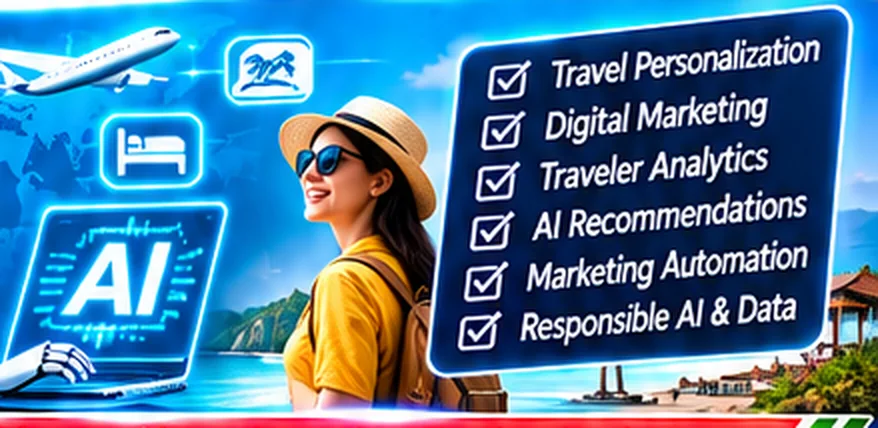
Personalize Travel Experiences with AI. Engage Travelers. Drive Bookings. Grow Your Tourism Business.

1. Program Overview

The Certified AI-Enabled Travel Personalization & Digital Marketing Professional (AITP-DMP)® is a professional-level certification that equips tourism, hospitality, and travel marketing professionals with practical knowledge and skills to apply Artificial Intelligence (AI), digital analytics, and marketing automation to enhance traveler engagement and deliver personalized travel experiences.

  • Apply AI and digital analytics to understand traveler behavior and preferences.
  • Design personalized marketing campaigns for travel customers.
  • Use AI-powered tools for recommendations, engagement, and customer communication.
  • Analyze marketing performance and optimize digital campaigns.
  • Implement responsible data practices and support digital tourism transformation.

Program at a Glance

Certification TitleCertified AI-Enabled Travel Personalization & Digital Marketing Professional
DesignationAITP-DMP®
Awarding OrganizationAAPSCM®
Certification LevelProfessional (Foundation)
Curriculum8 Comprehensive Modules
Learning ApproachIndustry-focused instruction, case studies, practical applications, and real-world scenarios
Virtual Instructor-Led Training4 days, 2 hours daily (8 live hours)
Self-Paced LearningFlexible study with exam preparation resources
Assessment Options (Virtual Instructor-Led)Choice of Certification Exam or Applied Capstone Project
Assessment (Self-Paced)Certification Exam Only (100 MCQs)
Certification Validity3 years (renewable per AAPSCM® policy)
Virtual Training Fee$1,200 USD
Self-Paced Fee (Exam Only)$399.99 USD
International ParticipationOpen to qualified global applicants
Industry Relevance

Build in-demand skills for the growing digital tourism and hospitality market.

Career Advancement

Strengthen your qualifications for tourism, hospitality, and digital marketing roles.

Digital Leadership

Develop skills to support AI-enabled tourism marketing and organizational digital transformation.

Program Video

3. Certification Learning Outcomes

Upon successful completion, you will be able to:

  • Explain how AI supports tourism marketing and traveler engagement.
  • Identify AI technologies used in travel personalization systems.
  • Analyze traveler behavior using digital analytics tools.
  • Develop personalized marketing campaigns for travel customers.
  • Use AI-powered marketing tools for customer engagement and communication.
  • Understand and apply digital tourism marketing platforms and channels.
  • Analyze marketing data to improve campaign performance and customer experience.
  • Apply responsible data practices and support digital tourism transformation.

A Practical, Industry-Focused Curriculum

Module 1AI & Digital Tourism Marketing Fundamentals
Module 2Traveler Behavior, Customer Journey & Data Analytics
Module 3AI Travel Personalization & Recommendation Systems
Module 4Digital Tourism Marketing Platforms & Campaign Automation
Module 5AI-Enabled Customer Engagement & Digital Concierge
Module 6Tourism Marketing Analytics & Performance Optimization
Module 7Responsible AI, Data Privacy & Marketing Governance
Module 8Digital Tourism Innovation & Future Marketing Trends
Training OptionDurationAssessmentFee
Virtual Instructor-Led (Online)4 Days (2 Hours Daily) 8 Live HoursChoice of: • Certification Exam (100 MCQs, 90 Minutes), or • Applied Capstone Project$1,200 USD
Self-Paced Learning (Exam Only)Flexible (Independent Study)Certification Exam Only (100 MCQs, 90 Minutes) Passing Score: 70%$399.99 USD
In-Seat / HyFlex (Columbia, SC, USA)Scheduled Cohort (Instructor-Led)Certification Exam or Applied Capstone Project (As Applicable)$1,250 USD

6. Career Pathways & Professional Roles

  • AI Tourism Marketing Specialist
  • Travel Personalization Specialist
  • Digital Tourism Marketing Professional
  • Destination Marketing Analyst
  • Hospitality Digital Marketing Specialist
  • Tourism Marketing Analytics Analyst
  • Customer Engagement Specialist
  • Travel Technology Coordinator
  • Digital Tourism Transformation Manager
  • Tourism Marketing Consultant
ISO 22483 Tourism Services
ISO/IEC 27001 Information Security
ISO 9001 Quality Management
ISO/IEC 42001 AI Management
ISO 31000 Risk Management
UN Tourism Digital Transformation
Travel Personalization
Digital Marketing
Traveler Analytics
Campaign Automation
Data Privacy & Governance
Customer Engagement
Tourism Innovation
Enroll Today »

Advance Your Career in AI-Enabled Tourism Marketing with AAPSCM®

Choose Your Pathway and Enroll

More about AITP-DMP®

The complete program information, in one place. Swipe sideways or use the arrows to browse each topic.

1
Program Overview

Transforming Travel Personalization and Digital Tourism Marketing Through Artificial Intelligence

The global travel and tourism industry is experiencing a significant digital transformation as organizations increasingly integrate artificial intelligence (AI), machine learning, predictive analytics, generative AI, customer intelligence platforms, and automated marketing technologies into their operations.

Modern travelers expect more than traditional travel advertisements, generic destination recommendations, and standardized vacation packages. They increasingly seek personalized travel experiences, relevant destination suggestions, convenient digital interactions, timely communication, and travel services that reflect their interests, preferences, budgets, and individual circumstances.

For tourism organizations, meeting these expectations requires a combination of marketing expertise, technology awareness, customer analytics, responsible data management, and the ability to translate traveler information into meaningful engagement strategies.

The Certified AI-Enabled Travel Personalization & Digital Marketing Professional (AITP-DMP)® is a professional-level certification developed and awarded by AAPSCM® to equip tourism, hospitality, travel marketing, and digital transformation professionals with the foundational knowledge and practical competencies needed to participate in AI-enabled tourism marketing environments.

The certification introduces participants to the application of artificial intelligence in traveler personalization, digital marketing automation, customer segmentation, traveler behavior analytics, recommendation systems, destination promotion, customer engagement, and marketing performance evaluation.

Participants explore how AI-enabled technologies can help tourism organizations better understand traveler needs, improve marketing relevance, develop personalized travel offers, evaluate customer engagement, and support data-driven business decisions.

The program also emphasizes responsible AI practices, traveler data protection, privacy considerations, ethical marketing, and human oversight.

Unlike programs that focus exclusively on general digital marketing, AITP-DMP® integrates marketing technologies with the distinctive commercial and service requirements of travel and tourism organizations.

What Makes AITP-DMP® Different?

The certification connects six essential professional disciplines:

  • Artificial Intelligence and Tourism Marketing
  • Traveler Behavior and Customer Intelligence
  • AI-Enabled Travel Personalization
  • Digital Tourism Marketing and Automation
  • Customer Engagement and Marketing Performance Analytics
  • Responsible AI, Data Governance, and Digital Tourism Innovation

AITP-DMP® prepares professionals to understand the technologies shaping modern tourism marketing and apply that knowledge to improve traveler engagement and organizational marketing effectiveness.

2
Why AI-Enabled Travel Personalization Matters

The Future of Tourism Marketing Is Personalized, Predictive, and Data-Driven

Tourism marketing is evolving from broad promotional campaigns toward more personalized, technology-enabled customer experiences.

Traditional marketing approaches often communicate the same travel offers to large audiences, regardless of differences in travel preferences, spending patterns, destination interests, or booking behavior.

AI-enabled marketing allows organizations to analyze relevant customer information, identify audience segments, recommend suitable travel products, and support more timely marketing communications.

2.1 Travelers Expect Personalized Experiences

Travelers may have different preferences regarding destinations, accommodation types, transportation options, activities, travel budgets, accessibility needs, and trip durations.

AI-enabled personalization systems can help organizations identify relevant preferences and develop more appropriate travel recommendations.

2.2 Digital Competition Is Increasing

Hotels, airlines, online travel agencies, destination marketing organizations, and tourism service providers compete for traveler attention across search engines, websites, mobile applications, social media, and digital booking platforms.

Professionals need to understand how digital channels influence traveler discovery and purchasing decisions.

2.3 Traveler Data Is Becoming a Strategic Resource

Travel organizations collect information through booking systems, customer inquiries, loyalty programs, website interactions, and marketing campaigns.

When collected and processed lawfully, this information can help organizations better understand traveler interests and improve marketing relevance.

2.4 AI Can Improve Marketing Efficiency

AI-assisted technologies can support customer segmentation, campaign scheduling, content recommendations, marketing analysis, and routine customer communication.

These capabilities can help marketing teams focus more attention on strategy, service quality, and customer relationships.

2.5 Customer Engagement Extends Beyond Booking

Traveler engagement includes inspiration, research, booking, predeparture communication, the travel experience, post-trip feedback, and future travel planning.

AI-enabled systems can support relevant communication throughout this journey.

2.6 Destination Marketing Requires Better Intelligence

Destination marketing organizations must understand visitor interests, travel patterns, seasonal demand, and campaign performance.

AI and analytics can support destination promotion and more informed marketing planning.

2.7 Responsible Data Practices Build Trust

Travel personalization frequently involves customer information and behavioral data.

Organizations must manage privacy, consent, cybersecurity, transparency, and data retention responsibly.

2.8 Tourism Professionals Need Emerging Technology Skills

The adoption of AI is changing the competencies expected of tourism marketing professionals.

AITP-DMP® provides a structured foundation for understanding these developments and participating in digital tourism transformation initiatives.

3
Why Choose AITP-DMP®?

A Professional Certification Designed for Modern Tourism Marketing

AI-Enabled Tourism Marketing Expertise

Understand how artificial intelligence supports destination marketing, travel promotion, customer segmentation, personalized recommendations, and digital engagement.

Traveler Personalization Competencies

Learn how organizations use traveler preferences, customer journey information, and behavioral analytics to develop more relevant travel experiences and marketing communications.

Digital Marketing Knowledge

Explore search marketing, social media marketing, email campaigns, digital advertising, content marketing, and tourism marketing automation.

Generative AI Applications

Understand how generative AI can assist with travel content creation, itinerary recommendations, multilingual communication, campaign concepts, and customer service support.

Practical Industry Applications

Study realistic scenarios involving hotels, travel agencies, airlines, tour operators, destination marketing organizations, and online travel services.

Marketing Analytics and Performance Measurement

Learn to interpret customer engagement indicators, marketing dashboards, campaign performance metrics, and traveler sentiment information.

Responsible AI and Data Governance

Develop awareness of customer privacy, consent, responsible personalization, cybersecurity, and ethical AI marketing practices.

Career Development

Strengthen professional knowledge relevant to digital tourism marketing, customer experience, travel technology, destination promotion, and hospitality marketing.

4
Why Earn Your Certification Through AAPSCM®?

Industry-Focused Professional Development for the Digital Tourism Economy

AAPSCM® develops professional education and certification programs covering procurement, supply chain management, tourism, and related professional disciplines.

AITP-DMP® reflects the growing importance of artificial intelligence, digital transformation, and customer intelligence within tourism marketing.

Specialized Tourism Technology Curriculum

The program focuses on AI and digital marketing applications relevant to travel and tourism rather than presenting technology concepts without industry context.

Structured Professional Learning

Eight knowledge modules guide candidates from foundational concepts through personalization, analytics, governance, and innovation.

Flexible Training Options

Participants can select independent examination preparation, virtual instructor-led training, or available in-seat and HyFlex training arrangements.

Applied Business Perspective

The curriculum connects technology knowledge with marketing objectives, traveler satisfaction, customer engagement, and organizational performance.

Responsible Technology Adoption

Participants examine the importance of privacy, ethical marketing, transparent AI practices, and human oversight.

Professional Development Opportunities

Certification holders may explore relevant AAPSCM® professional learning activities, networking events, and continuing education opportunities, subject to applicable requirements.

5
Target Audience — Who Should Enroll?

The AITP-DMP® certification is designed for individuals who want to develop foundational expertise in AI-enabled tourism marketing and traveler personalization.

Tourism Marketing Professionals

Professionals responsible for destination promotion, tourism campaigns, travel advertising, and marketing communication.

Travel Agency Professionals

Travel consultants, agency managers, reservation specialists, and professionals involved in travel package promotion and customer engagement.

Destination Marketing Organization Professionals

Destination marketing staff, tourism promotion officers, visitor engagement specialists, and destination development professionals.

Hospitality Marketing Professionals

Hotel marketing managers, guest experience professionals, resort marketing specialists, and hospitality digital marketing teams.

Airline and Transportation Marketing Professionals

Airline marketing personnel, customer engagement teams, loyalty program professionals, and travel service marketing specialists.

Digital Marketing Specialists

Professionals working in social media marketing, search marketing, marketing automation, digital advertising, and content strategy.

Travel Technology Professionals

Individuals supporting tourism platforms, booking systems, customer relationship management applications, and travel marketing technologies.

Tourism Entrepreneurs and Consultants

Travel business owners, destination consultants, tourism startups, and independent professionals seeking to improve digital marketing capabilities.

Students and Emerging Professionals

Graduates and early-career professionals interested in tourism, hospitality, marketing, business analytics, and emerging technologies.

Prerequisites: No advanced programming background is required. Basic familiarity with tourism, hospitality, marketing, or digital business concepts is helpful.

6
Comprehensive Certification Learning Outcomes

Upon successful completion of AITP-DMP®, candidates should be able to demonstrate foundational knowledge and applied understanding across the following areas.

AI Tourism Marketing Fundamentals

  • Explain the role of AI in tourism and hospitality marketing.
  • Distinguish AI, machine learning, predictive analytics, and generative AI.
  • Identify common AI marketing applications.
  • Recognize opportunities and limitations of AI adoption.

Traveler Behavior and Customer Intelligence

  • Explain the traveler decision-making journey.
  • Identify relevant traveler data sources.
  • Interpret customer segmentation information.
  • Recognize behavioral patterns and customer preferences.

Travel Personalization

  • Explain how recommendation systems support travel personalization.
  • Identify suitable personalization approaches.
  • Evaluate personalized travel offers.
  • Recognize the importance of customer consent and appropriate data use.

Digital Marketing Platforms

  • Identify major digital tourism marketing channels.
  • Explain search engine optimization and paid search marketing.
  • Understand social media advertising.
  • Recognize marketing automation capabilities.

Customer Engagement

  • Explain AI-enabled traveler communication.
  • Identify applications of generative AI assistants and digital concierge systems.
  • Understand automated email and customer engagement workflows.
  • Recognize situations requiring human intervention.

Marketing Analytics

  • Interpret campaign performance indicators.
  • Explain conversion rates and customer engagement metrics.
  • Understand marketing dashboards.
  • Evaluate opportunities for campaign improvement.

Responsible AI and Governance

  • Identify traveler privacy risks.
  • Explain responsible AI marketing principles.
  • Recognize information security considerations.
  • Understand the importance of transparency and human oversight.

Digital Tourism Innovation

  • Identify emerging travel technologies.
  • Explain digital transformation concepts.
  • Recognize opportunities for tourism marketing innovation.
  • Evaluate organizational readiness for technology adoption.
7
Comprehensive Certification Curriculum — Eight Professional Modules

Module 1: Foundations of Artificial Intelligence and Digital Tourism Marketing

Objective: Establish a foundational understanding of digital tourism marketing, artificial intelligence, and the technologies transforming traveler engagement.

1.1 Evolution of Tourism Marketing

  • Traditional tourism promotion
  • Development of online travel marketing
  • Growth of digital booking platforms
  • Mobile-first travel marketing
  • Changing traveler expectations
  • Personalized tourism marketing

1.2 Digital Tourism Marketing Ecosystems

  • Travel agency websites
  • Online travel agencies
  • Airline and hotel booking platforms
  • Destination marketing websites
  • Social media platforms
  • Customer relationship management systems

1.3 Fundamentals of Artificial Intelligence

  • Artificial intelligence concepts
  • Machine learning fundamentals
  • Predictive analytics
  • Natural language processing
  • Generative AI
  • Recommendation technologies

1.4 AI Applications in Tourism Marketing

  • Personalized destination recommendations
  • Automated customer segmentation
  • AI-assisted marketing content
  • Traveler behavior analysis
  • Digital customer engagement
  • Marketing performance insights

1.5 Benefits and Limitations

  • Potential operational efficiencies
  • Improved marketing relevance
  • Data quality challenges
  • AI-generated content inaccuracies
  • Privacy considerations
  • Human oversight requirements

Practical Learning Activity: Evaluate a tourism organization's digital marketing channels and identify opportunities for responsible AI-enabled improvements.

Expected Competency: Explain the role of AI in tourism marketing and identify appropriate applications within travel organizations.

Module 2: Traveler Behavior, Customer Journey Mapping, and Data Analytics

Objective: Develop the ability to understand traveler behavior, identify relevant customer information, and interpret tourism marketing analytics.

2.1 Understanding Traveler Behavior

  • Travel motivations
  • Destination preferences
  • Budget considerations
  • Booking behavior
  • Seasonal travel patterns
  • Customer decision factors

2.2 Traveler Journey Mapping

  • Travel inspiration
  • Destination research
  • Travel comparison
  • Booking decisions
  • Predeparture engagement
  • In-destination experience
  • Post-trip communication

2.3 Traveler Data Sources

  • Website analytics
  • Booking information
  • Customer inquiries
  • Loyalty programs
  • Customer surveys
  • Social media engagement
  • Customer feedback

2.4 Customer Segmentation

  • Demographic segmentation
  • Geographic segmentation
  • Behavioral segmentation
  • Travel preference segmentation
  • Booking history analysis
  • Customer value considerations

2.5 Tourism Analytics

  • Website traffic
  • Customer engagement
  • Booking conversion
  • Campaign performance
  • Customer acquisition
  • Repeat booking behavior

2.6 Responsible Traveler Data Analysis

  • Data minimization
  • Consent
  • Data accuracy
  • Access controls
  • Privacy considerations

Practical Learning Activity: Develop a traveler journey map and customer segmentation plan for a selected hotel, airline, travel agency, or destination.

Expected Competency: Interpret foundational traveler analytics and recommend appropriate customer engagement strategies.

Module 3: AI-Driven Travel Personalization and Intelligent Recommendation Systems

Objective: Understand how AI-enabled technologies support personalized travel recommendations, customized marketing offers, and relevant customer experiences.

3.1 Foundations of Travel Personalization

  • Personalized versus generic marketing
  • Traveler preference analysis
  • Customer segmentation
  • Personalization objectives

3.2 AI Recommendation Engines

  • Content-based recommendations
  • Collaborative filtering concepts
  • Preference-based recommendations
  • Context-aware personalization
  • Recommendation quality

3.3 Personalized Travel Offers

  • Destination recommendations
  • Accommodation suggestions
  • Travel activity recommendations
  • Package customization
  • Personalized promotional communications

3.4 Predictive Traveler Analytics

  • Booking likelihood
  • Customer engagement patterns
  • Travel interest indicators
  • Repeat booking behavior
  • Demand trends

3.5 Generative AI in Travel Personalization

  • Personalized itinerary drafts
  • Travel content suggestions
  • Multilingual travel information
  • Customer communication assistance
  • AI-generated travel recommendations

3.6 Responsible Personalization

  • Customer consent
  • Transparency
  • Data minimization
  • Avoiding discriminatory targeting
  • Accuracy and human review

Practical Learning Activity: Design a personalized travel marketing campaign for three customer segments, including relevant destination offers, communication channels, and performance indicators.

Expected Competency: Recommend AI-enabled personalization approaches appropriate to different traveler needs.

Module 4: Digital Tourism Marketing Platforms, Search Marketing, and Campaign Automation

Objective: Develop foundational knowledge of the digital platforms and marketing technologies used to promote tourism products and services.

4.1 Tourism Digital Marketing Strategy

  • Marketing objectives
  • Target audience identification
  • Channel selection
  • Campaign planning
  • Budget considerations

4.2 Search Engine Optimization

  • Tourism keyword research
  • Destination content optimization
  • Website structure
  • Search visibility
  • Local tourism search

4.3 Search Engine Marketing

  • Paid search advertising
  • Campaign targeting
  • Advertising budgets
  • Keyword relevance
  • Conversion tracking

4.4 Social Media Marketing

  • Destination storytelling
  • Visual tourism promotion
  • Audience targeting
  • Social media advertising
  • Customer engagement
  • Campaign monitoring

4.5 Email Marketing and Automation

  • Customer segmentation
  • Email campaign scheduling
  • Personalized messaging
  • Automated customer journeys
  • Engagement measurement

4.6 Generative AI Marketing Applications

  • Travel campaign concepts
  • Promotional content drafts
  • Destination descriptions
  • Social media content assistance
  • Marketing message variations

4.7 Marketing Technology Integration

  • Customer relationship management
  • Marketing automation
  • Booking systems
  • Analytics platforms
  • Data integration considerations

Practical Learning Activity: Prepare a multichannel tourism marketing campaign combining search, social media, email marketing, and AI-assisted content development.

Expected Competency: Identify suitable digital marketing channels and explain how automation supports campaign execution.

Module 5: AI-Enabled Customer Engagement, Generative AI Assistants, and Digital Concierge Technologies

Objective: Understand how AI-enabled customer engagement technologies support traveler communication and service delivery.

5.1 Digital Traveler Engagement

  • Customer service expectations
  • Omnichannel communication
  • Response time considerations
  • Customer satisfaction
  • Service personalization

5.2 Generative AI Travel Assistants

  • Natural language interaction
  • Travel information support
  • Itinerary assistance
  • Booking-related inquiries
  • Multilingual communication

5.3 Digital Concierge Systems

  • Hotel guest assistance
  • Destination information
  • Local activity suggestions
  • Travel service information
  • Guest experience support

5.4 Customer Engagement Automation

  • Automated email communication
  • Booking reminders
  • Predeparture messages
  • Post-trip feedback requests
  • Customer inquiry routing

5.5 Human-AI Collaboration

  • Human escalation
  • Complex customer requests
  • Service recovery
  • Accuracy verification
  • Customer trust

5.6 Customer Engagement Performance

  • Response times
  • Customer satisfaction
  • Inquiry resolution
  • Engagement rates
  • Service quality indicators

Practical Learning Activity: Design a customer engagement workflow for a travel agency or hotel using an AI assistant, automated communications, and human escalation procedures.

Expected Competency: Explain how AI-enabled engagement technologies can support traveler communication while maintaining service quality and accountability.

Module 6: Tourism Marketing Analytics, Campaign Performance, and Customer Sentiment Intelligence

Objective: Develop knowledge of marketing performance measurement and the use of analytical insights to improve tourism campaigns.

6.1 Tourism Marketing Performance

  • Marketing objectives
  • Key performance indicators
  • Campaign reporting
  • Performance monitoring

6.2 Digital Marketing Metrics

  • Website traffic
  • Click-through rates
  • Conversion rates
  • Customer acquisition cost
  • Return on advertising spend
  • Customer engagement

6.3 Marketing Dashboards

  • Dashboard fundamentals
  • Data visualization
  • Campaign reporting
  • Customer behavior analysis
  • Management summaries

6.4 Customer Sentiment Analysis

  • Online reviews
  • Customer feedback
  • Social media comments
  • Sentiment classification
  • Service improvement opportunities

6.5 AI-Assisted Campaign Optimization

  • Audience performance comparison
  • Campaign content evaluation
  • Marketing channel performance
  • A/B testing concepts
  • Budget allocation considerations

6.6 Reporting and Recommendations

  • Marketing performance summaries
  • Data interpretation
  • Campaign improvement proposals
  • Management communication

Practical Learning Activity: Analyze a sample tourism marketing dashboard and prepare recommendations for improving campaign engagement and booking conversion.

Expected Competency: Interpret marketing performance information and recommend data-supported improvements.

Module 7: Responsible AI, Traveler Data Privacy, Cybersecurity, and Tourism Marketing Governance

Objective: Develop foundational competencies in ethical AI marketing, traveler privacy, information security, and responsible data governance.

7.1 Responsible AI Principles

  • Transparency
  • Accountability
  • Fairness
  • Human oversight
  • Reliability
  • Appropriate AI use

7.2 Traveler Data Privacy

  • Personal information
  • Customer consent
  • Data collection limitations
  • Data retention
  • Privacy notices
  • Customer rights

7.3 Privacy and Regulatory Awareness

  • GDPR concepts
  • Applicable U.S. privacy requirements
  • Cross-border data considerations
  • Marketing communication consent
  • Organizational privacy policies

7.4 Cybersecurity Fundamentals

  • Customer information security
  • Access controls
  • Account protection
  • Third-party platform risks
  • Data breach awareness

7.5 Ethical Personalization

  • Avoiding manipulative targeting
  • Appropriate customer profiling
  • Preventing discriminatory practices
  • Responsible use of sensitive information
  • Customer choice

7.6 AI Marketing Governance

  • AI use policies
  • Human review procedures
  • Vendor assessment
  • Model limitations
  • Marketing content verification
  • Documentation

Practical Learning Activity: Prepare a responsible AI marketing checklist for a tourism organization using traveler data, automated campaigns, and AI-generated travel recommendations.

Expected Competency: Identify privacy, security, and ethical risks associated with AI-enabled tourism marketing.

Module 8: Digital Tourism Innovation, Emerging AI Technologies, and Future Marketing Trends

Objective: Understand emerging tourism technologies and the organizational requirements for responsible digital transformation.

8.1 Digital Tourism Transformation

  • Digital business models
  • Tourism technology adoption
  • Customer experience innovation
  • Organizational readiness

8.2 Emerging AI Travel Platforms

  • Intelligent travel assistants
  • AI-enabled booking support
  • Travel recommendation systems
  • Predictive tourism analytics
  • Personalized digital experiences

8.3 Immersive Tourism Technologies

  • Virtual reality destination previews
  • Augmented reality tourism applications
  • Interactive destination experiences
  • Immersive marketing

8.4 Smart Tourism Ecosystems

  • Connected tourism services
  • Digital destination platforms
  • Tourism information systems
  • Smart destination concepts

8.5 Generative AI and Tourism Innovation

  • AI-assisted destination content
  • Personalized travel planning
  • Multilingual marketing
  • Marketing workflow support
  • Content quality assurance

8.6 Organizational Implementation

  • Technology readiness
  • Staff training
  • Budget planning
  • Stakeholder engagement
  • Vendor evaluation
  • Implementation monitoring

8.7 Future Professional Competencies

  • AI literacy
  • Digital marketing analytics
  • Customer experience management
  • Responsible data practices
  • Technology evaluation
  • Continuous professional learning

Practical Learning Activity: Develop a digital tourism marketing improvement roadmap for a travel organization, including proposed technologies, implementation phases, governance considerations, and performance indicators.

Expected Competency: Evaluate emerging tourism technologies and recommend practical digital marketing improvements.

8
Modern Tools and Technologies

The AITP-DMP® curriculum introduces candidates to representative platforms and technology categories used in tourism marketing.

Digital Marketing Platforms

Google Marketing Platform

Introduces digital advertising, campaign measurement, and marketing performance concepts.

Meta Ads Manager

Supports understanding of audience targeting, social media advertising, and campaign performance measurement.

HubSpot Marketing Automation

Illustrates customer relationship management, automated communication, and digital marketing workflows.

Salesforce Marketing Cloud

Provides examples of customer engagement, marketing automation, and personalized communication systems.

Business Intelligence and Analytics

Google Analytics

Website engagement, customer behavior, and digital conversion measurement.

Microsoft Power BI

Marketing dashboard development, performance visualization, and analytical reporting.

Tableau

Interactive visualization and business intelligence applications.

AI Marketing Technologies

  • Generative AI assistants
  • AI recommendation engines
  • Traveler segmentation systems
  • Predictive customer analytics
  • Customer sentiment analysis
  • Automated marketing workflows

Tourism Technology Systems

  • Online booking platforms
  • Hotel property management systems
  • Customer relationship management platforms
  • Destination marketing systems
  • Digital concierge applications
  • Travel customer engagement systems

Technology Note: The curriculum references representative technologies for educational purposes. Software licenses, paid subscriptions, and vendor-specific certifications are not included unless expressly stated in the applicable enrollment arrangement.

9
AAPSCM® AI Tourism Marketing Framework

Five Pillars of Intelligent Tourism Marketing

The AAPSCM® AI Tourism Marketing Framework organizes professional competencies into five interconnected pillars.

Pillar 1: AI Personalization Strategy

Focuses on understanding traveler preferences and using AI-enabled recommendations to improve marketing relevance.

Core Competencies

  • Customer segmentation
  • Personalized travel offers
  • Recommendation systems
  • Traveler journey personalization
  • Customer experience design

Pillar 2: Traveler Data Intelligence

Focuses on interpreting traveler information and using analytics to support marketing decisions.

Core Competencies

  • Traveler behavior analysis
  • Customer journey mapping
  • Marketing analytics
  • Audience segmentation
  • Data quality awareness

Pillar 3: Digital Marketing Optimization

Focuses on improving tourism marketing campaigns through digital channels and analytical insights.

Core Competencies

  • Search marketing
  • Social media marketing
  • Campaign measurement
  • Marketing automation
  • Performance optimization

Pillar 4: Customer Engagement Automation

Focuses on technology-enabled traveler communication and customer service support.

Core Competencies

  • Generative AI assistants
  • Automated communications
  • Digital concierge systems
  • Customer engagement workflows
  • Human escalation procedures

Pillar 5: Responsible AI Marketing

Focuses on governance, privacy, transparency, and ethical AI use.

Core Competencies

  • Traveler privacy
  • Data protection
  • AI accountability
  • Marketing ethics
  • Human oversight

Framework Application

Organizations can use these pillars as a conceptual guide when evaluating their tourism marketing capabilities, identifying training needs, and planning responsible AI adoption.

10
AAPSCM® AI Tourism Marketing Maturity Model

Five Levels of Digital Tourism Marketing Development

Maturity LevelDescriptionOrganizational Characteristics
Level 1 — TraditionalConventional tourism marketingPrimarily manual campaigns, limited analytics, and generic promotions
Level 2 — Digitally EnabledAdoption of digital marketing channelsWebsites, email campaigns, social media, and basic performance reporting
Level 3 — Data-DrivenAnalytics-informed tourism marketingCustomer segmentation, campaign measurement, and structured marketing dashboards
Level 4 — AI-Enabled PersonalizationAI-supported marketing decisionsPersonalized recommendations, predictive analytics, and AI-assisted customer engagement
Level 5 — Intelligent Tourism Marketing EcosystemIntegrated and continuously optimized digital marketingCoordinated AI-enabled workflows, advanced analytics, governance, and human-supervised automation

How Organizations Can Apply the Model

Tourism organizations may use the maturity model to:

  • Evaluate existing digital marketing capabilities.
  • Identify technology and workforce development gaps.
  • Prioritize marketing modernization initiatives.
  • Improve customer analytics and personalization.
  • Develop responsible AI governance practices.
  • Establish measurable digital transformation objectives.

The model is intended as a professional development and organizational self-assessment framework, not as an independently accredited maturity rating.

11
Executive Competency Framework

The AITP-DMP® certification develops six primary professional competency areas.

CompetencyProfessional Capability
AI Tourism Marketing KnowledgeExplain AI applications in travel and tourism marketing
Traveler Data IntelligenceInterpret customer behavior and marketing analytics
Personalization StrategyRecommend relevant travel personalization approaches
Digital Marketing PlatformsUnderstand tourism marketing channels and automation
Customer Engagement AutomationEvaluate AI-enabled traveler communication systems
Tourism Data GovernanceRecognize privacy, security, and responsible AI requirements

Professional Application

These competencies support tourism marketing practitioners who need to understand AI technologies, evaluate marketing information, communicate with technology teams, and contribute to responsible digital marketing initiatives.

12
AITP-DMP® Body of Knowledge (BOK)

The certification Body of Knowledge defines the principal subject areas assessed through the program.

Knowledge DomainScope
AI Tourism Marketing FundamentalsAI concepts, tourism applications, and digital marketing transformation
Traveler Data IntelligenceTraveler behavior, segmentation, customer journey analysis, and analytics
Travel Personalization TechnologiesRecommendation engines, personalized offers, and predictive customer insights
Digital Tourism Marketing PlatformsSearch marketing, social media, digital advertising, and marketing automation
Customer Engagement AutomationGenerative AI assistants, digital concierge systems, and customer communication
Tourism Marketing AnalyticsMarketing KPIs, dashboards, sentiment analysis, and campaign optimization
Tourism Data GovernancePrivacy, cybersecurity, ethical AI, and responsible marketing
Tourism Digital TransformationEmerging technologies, organizational readiness, and innovation
13
International Standards and Professional Frameworks

The AITP-DMP® curriculum incorporates concepts relevant to established standards and professional guidance.

ISO 22483 — Tourism and Related Services

Relevant to hotel service quality, guest experience, and hospitality service expectations.

ISO/IEC 27001 — Information Security Management Systems

Relevant to protecting traveler information and managing information security risks.

ISO 9001 — Quality Management Systems

Relevant to process quality, service consistency, customer satisfaction, and continuous improvement.

ISO 56002 — Innovation Management Systems Guidance

Relevant to organizational innovation, technology adoption, and innovation management practices.

ISO/IEC 42001 — Artificial Intelligence Management Systems

Relevant to responsible AI governance, accountability, and organizational management of AI technologies.

ISO 31000 — Risk Management Guidelines

Relevant to identifying, assessing, and managing technology and operational risks.

UN Tourism Guidance and Digital Transformation Initiatives

Relevant to digital tourism development, tourism innovation, and responsible technology adoption.

Important Clarification: References to standards and international frameworks describe curriculum relevance and conceptual alignment. They do not imply that AAPSCM®, this certification, or its participants are accredited, certified, or endorsed by the referenced organizations.

14
Training Delivery Options, Duration, and Fees

AAPSCM® offers flexible learning and assessment arrangements for individuals and corporate teams.

Option 1: Self-Paced Learning and Certification Examination

Program Fee: $399.99 USD

This pathway is intended for professionals who prefer independent study and examination preparation.

Included

  • Certification examination registration
  • Complimentary examination preparation guide
  • Complimentary practice questions
  • Access to applicable digital preparation materials
  • Certification assessment processing

Learning Duration

Recommended preparation period: six to eight weeks, depending on prior knowledge and study availability.

Assessment Requirement

Certification examination only.

Self-paced candidates must pass the certification examination. The capstone pathway is not available as a substitute for the self-paced examination.

Option 2: Virtual Instructor-Led Training

Program Fee: $1,200 USD

Duration

Four days of live online training, two hours daily.

Total Live Instruction: Eight Hours

Learning Experience

  • Instructor-guided explanations
  • Tourism marketing case studies
  • AI personalization demonstrations
  • Traveler analytics examples
  • Digital marketing discussions
  • Customer engagement scenarios
  • Responsible AI applications

Assessment Options

Virtual instructor-led candidates may select either the certification examination or an approved applied capstone project, subject to AAPSCM® assessment policies.

Option 3: In-Seat or HyFlex Training

Program Fee: $1,250 USD

Training Location

AAPSCM® Conference CenterColumbia, South Carolina, USA

This option provides an instructor-led learning environment with opportunities for discussion, demonstrations, and professional interaction.

Training dates, classroom arrangements, and HyFlex availability are subject to scheduled cohorts.

Assessment arrangements should be confirmed during registration.

Option 4: Corporate On-Site Training

Corporate training is available by arrangement for tourism organizations, hotels, airlines, travel agencies, destination marketing organizations, and other eligible employers.

Corporate Training Topics

  • AI tourism marketing fundamentals
  • Travel personalization
  • Traveler behavior analytics
  • Generative AI marketing
  • Digital campaign optimization
  • Customer engagement automation
  • Tourism marketing governance

Corporate Training Inquiries: [email protected]

Training Fee Comparison

Training OptionDurationFeeAssessment
Self-PacedRecommended 6–8 weeks$399.99Examination only
Virtual Instructor-Led4 days, 2 hours daily$1,200Examination or approved capstone
In-Seat / HyFlexScheduled cohort$1,250Confirm during registration
Corporate On-SiteCustomizedBy quotationAs agreed
15
Certification Examination and Assessment Requirements

Demonstrate Foundational Knowledge of AI-Enabled Tourism Marketing

The AITP-DMP® certification examination evaluates a candidate's understanding of artificial intelligence, traveler personalization, digital marketing technologies, customer engagement, tourism analytics, and responsible data practices.

Examination Structure

  • Examination Format: Multiple-Choice Questions
  • Total Questions: 100
  • Duration: 90 Minutes
  • Minimum Passing Score: 70%
  • Minimum Correct Answers: 70
  • Delivery: Secure online proctored examination
  • Certification Level: Professional — Foundational

Proposed Examination Blueprint

ModuleKnowledge AreaQuestionsWeight
1AI and Digital Tourism Marketing Foundations1515%
2Traveler Behavior and Data Analytics1515%
3AI Travel Personalization1515%
4Digital Tourism Marketing Platforms1515%
5Customer Engagement Technologies1010%
6Marketing Analytics and Performance1010%
7Responsible AI and Data Governance1010%
8Digital Tourism Innovation1010%
Total100100%

This distribution is a recommended blueprint for formal AAPSCM® approval.

Examination Competencies

Questions may evaluate the ability to:

  • Identify appropriate AI marketing technologies.
  • Interpret traveler behavior information.
  • Recognize effective personalization strategies.
  • Evaluate digital marketing channels.
  • Explain automated customer engagement.
  • Interpret basic marketing performance indicators.
  • Identify privacy and ethical risks.
  • Recognize emerging tourism technologies.
16
Applied Capstone Project — Eligible Virtual Instructor-Led Participants

Designing an AI-Enabled Travel Personalization and Digital Tourism Marketing Strategy

Project Objective

The applied capstone provides eligible virtual instructor-led participants with an opportunity to demonstrate their understanding of AI-enabled tourism marketing through a realistic organizational scenario.

Business Scenario

A destination marketing organization seeks to improve visitor engagement, attract new travelers, increase interest in local tourism experiences, and strengthen its digital marketing performance.

Its current marketing activities rely primarily on generic promotional messages, basic social media campaigns, and limited customer segmentation.

Management wants to introduce AI-assisted personalization, customer analytics, automated marketing communications, and improved performance measurement.

The participant must develop a professional digital tourism marketing transformation proposal.

Required Project Components

Part 1 — Organizational Marketing Assessment

Review the organization's current marketing channels, customer engagement practices, and marketing challenges.

Part 2 — Traveler Audience Analysis

Identify relevant traveler segments and describe their preferences, interests, and travel planning behaviors.

Part 3 — Traveler Journey Mapping

Map the traveler journey from initial destination discovery through post-trip engagement.

Part 4 — AI Personalization Strategy

Recommend appropriate personalization approaches, including destination recommendations and targeted marketing communications.

Part 5 — Digital Marketing Campaign

Develop a campaign using selected digital channels and AI-assisted marketing content.

Part 6 — Customer Engagement Automation

Design an automated traveler communication workflow incorporating human oversight.

Part 7 — Marketing Analytics

Identify relevant KPIs and develop a proposed marketing performance dashboard.

Part 8 — Responsible AI and Data Governance

Address traveler privacy, consent, information security, content accuracy, and ethical marketing considerations.

Part 9 — Implementation Roadmap

Recommend implementation phases, workforce requirements, technology considerations, and performance monitoring.

Capstone Deliverables

  • Executive summary
  • Organizational marketing assessment
  • Traveler segmentation analysis
  • Customer journey map
  • AI personalization strategy
  • Digital marketing campaign proposal
  • Customer engagement workflow
  • Marketing performance indicators
  • Responsible AI governance checklist
  • Implementation roadmap
  • Final recommendations

Proposed Capstone Evaluation Rubric

Assessment CriteriaWeight
Marketing Situation Analysis10%
Traveler Segmentation10%
Traveler Journey Mapping10%
AI Personalization Strategy15%
Digital Marketing Campaign15%
Customer Engagement Automation10%
Marketing Analytics and KPIs10%
Responsible AI and Privacy10%
Implementation Roadmap5%
Professional Report Quality5%
Total100%

Recommended Minimum Passing Score: 70%.

The capstone is an alternative assessment only where expressly approved for the relevant training pathway.

17
Certification Progression and Professional Development

From Foundational Professional Competence to Tourism Marketing Leadership

AAPSCM® identifies a two-level progression structure for AI-enabled travel personalization and digital marketing.

Level 1 — Professional

Certified AI-Enabled Travel Personalization & Digital Marketing Professional (AITP-DMP)®

Focuses on foundational knowledge of AI tourism marketing, traveler personalization, digital platforms, marketing analytics, and responsible technology use.

Level 2 — Manager

Certified AI-Enabled Travel Personalization & Digital Marketing Manager (AITP-DMM)®

The proposed managerial progression focuses on advanced responsibilities such as marketing strategy, digital transformation leadership, AI implementation planning, marketing performance management, and organizational governance.

Progression eligibility and any separate assessment requirements are subject to AAPSCM® policies.

18
Industry Applications

Hotels and Resorts

AI-enabled personalization can support guest communication, promotional offers, customer segmentation, and hospitality marketing performance.

Airlines

Marketing teams can apply customer analytics and personalization principles to traveler engagement, loyalty communication, and relevant service promotion.

Travel Agencies

Travel agencies can use AI-assisted technologies to support destination recommendations, customer inquiries, personalized packages, and digital marketing campaigns.

Tour Operators

Tour operators can apply customer segmentation, travel preference analysis, and marketing automation to promote suitable travel experiences.

Destination Marketing Organizations

Destination marketing professionals can use visitor analytics, personalized destination campaigns, and digital performance reporting.

Online Travel Platforms

Digital travel businesses can apply recommendation systems, customer journey analysis, and engagement automation.

Cruise and Leisure Tourism

Marketing professionals can use customer segmentation and digital engagement strategies to promote cruise packages and leisure experiences.

Cultural and Heritage Tourism

Tourism organizations can develop more targeted promotional campaigns while respecting cultural authenticity and responsible marketing practices.

Meetings, Incentives, Conferences, and Exhibitions

Event tourism professionals can use analytics and digital marketing automation to support attendee engagement and event promotion.

19
Career Pathways and Professional Opportunities

The AITP-DMP® certification supports professional development relevant to tourism marketing, customer experience, and digital technology roles.

AI Tourism Marketing Specialist

Supports AI-enabled marketing campaigns, traveler segmentation, and personalized tourism promotion.

Travel Personalization Specialist

Develops or supports strategies for personalized travel recommendations and customer engagement.

Digital Tourism Marketing Professional

Coordinates digital campaigns across search, social media, email, and travel marketing platforms.

Destination Marketing Analyst

Analyzes visitor behavior, destination campaign performance, and tourism marketing information.

Hospitality Digital Marketing Specialist

Supports hotel and resort marketing through digital channels and customer analytics.

Tourism Customer Experience Specialist

Evaluates traveler communication, engagement workflows, and customer experience improvements.

Tourism Marketing Analytics Professional

Interprets marketing performance indicators and supports data-driven campaign decisions.

Travel Technology Implementation Coordinator

Supports organizational adoption of travel marketing technologies and digital engagement platforms.

AI-Enabled Customer Engagement Specialist

Assists with AI-powered traveler communication and customer service automation.

Tourism Digital Transformation Coordinator

Supports technology adoption, marketing modernization, and organizational change initiatives.

Career Clarification: The certification supports professional competency development but does not guarantee employment, promotion, salary increases, or qualification for roles requiring additional education or experience.

20
Certification Validity and Continuing Professional Development

Certification Validity

The AITP-DMP® credential is valid for three years from its issuance date, subject to AAPSCM® certification policies.

Continuing Professional Development

Certification holders are encouraged to maintain knowledge in:

  • Artificial intelligence
  • Generative AI
  • Digital tourism marketing
  • Traveler personalization
  • Marketing automation
  • Customer analytics
  • Customer experience management
  • Responsible AI governance
  • Data privacy
  • Digital tourism innovation

Renewal

Certification renewal is subject to applicable AAPSCM® requirements, which may include continuing professional development, documentation, reassessment, or renewal fees.

21
Frequently Asked Questions

1. What is AITP-DMP®?

AITP-DMP® is a professional certification focused on AI-enabled travel personalization, digital tourism marketing, customer analytics, marketing automation, and responsible AI practices.

2. Is the certification suitable for beginners?

Yes. The program is designed at the professional foundational level.

3. Is programming knowledge required?

No advanced programming knowledge is required for foundational participation.

4. Who awards the certification?

AAPSCM® — American Association of Procurement, Supply Chain & Tourism Management.

5. How many modules are included?

Eight comprehensive professional modules.

6. What is the self-paced fee?

$399.99 USD.

7. How long should self-paced candidates study?

The recommended preparation period is six to eight weeks, although actual preparation time depends on individual experience and availability.

8. What is the virtual instructor-led training fee?

$1,200 USD.

9. How long is virtual training?

Four days, with two hours of live instruction daily.

10. What is the in-seat or HyFlex training fee?

$1,250 USD.

11. Where is in-seat training offered?

AAPSCM® Conference Center, Columbia, South Carolina, subject to scheduled availability.

12. How many examination questions are included?

100 multiple-choice questions.

13. How long is the examination?

90 minutes.

14. What is the passing score?

70%.

15. Can self-paced candidates submit a capstone instead of taking the examination?

No. The self-paced pathway requires the certification examination.

16. Can virtual instructor-led candidates choose a capstone?

Yes, where the approved training and assessment arrangements provide that option.

17. Does the program include generative AI?

Yes. Generative AI applications are incorporated into relevant modules covering personalization, marketing content, and customer engagement.

18. Does the program cover traveler privacy?

Yes. Module 7 focuses on responsible AI, traveler data privacy, information security, and governance.

19. Can international candidates participate?

Yes, subject to applicable registration and assessment requirements.

20. Is there an advanced certification pathway?

The program identifies the Certified AI-Enabled Travel Personalization & Digital Marketing Manager (AITP-DMM)® as the next professional progression.

21. How long is the certification valid?

Three years.

22. Does the certification guarantee employment?

No. It supports professional development and does not guarantee employment or promotion.

22
How to Enroll

Begin Your Professional Development in AI-Enabled Tourism Marketing

Step 1 — Choose Your Training Pathway

Select self-paced learning, virtual instructor-led training, or an available in-seat/HyFlex option.

Step 2 — Register

Complete the applicable AAPSCM® registration process.

Step 3 — Pay the Program Fee

Submit the required payment for your selected training pathway.

Step 4 — Access Your Learning Resources

Receive the applicable examination preparation resources or training information.

Step 5 — Prepare for Assessment

Study the eight knowledge modules and complete relevant learning activities.

Step 6 — Complete the Applicable Assessment

Self-paced candidates must complete the certification examination.

Eligible virtual instructor-led candidates may complete the examination or an approved capstone project.

Step 7 — Receive Your Certification

Successful candidates who satisfy the applicable assessment and administrative requirements become eligible for the AITP-DMP® certification award.

23
Enroll Today — Build Your Future in AI-Enabled Tourism Marketing

Understand Travelers. Personalize Experiences. Optimize Marketing. Lead with AI.

Artificial intelligence is reshaping how tourism organizations attract travelers, communicate with customers, promote destinations, and deliver personalized experiences.

The professionals who understand these technologies will be better positioned to contribute to digital marketing initiatives, customer engagement improvements, and responsible tourism innovation.

The Certified AI-Enabled Travel Personalization & Digital Marketing Professional (AITP-DMP)® provides a structured learning pathway for developing the foundational knowledge required in this changing industry.

Whether you work in hospitality, destination marketing, travel agencies, airlines, tourism consulting, digital marketing, or travel technology, AITP-DMP® can help strengthen your understanding of intelligent tourism marketing.

Choose Your Enrollment Option

Self-Paced Learning and Examination — $399.99 USD

https://aapscm.org/checkout?add-to-cart=101685

Virtual Instructor-Led Training — $1,200 USD

https://aapscm.org/aapscm-training-virtual-certified-ai-enabled-travel-personalization-digital-marketing-professional-aitp-dmp/

In-Seat / HyFlex Training — $1,250 USD

https://aapscm.org/checkout?add-to-cart=101688

Corporate Training Inquiries

[email protected]

General Inquiries

[email protected]

Website

https://www.aapscm.org

Developed and Awarded by AAPSCM®

AITP-DMP® — Personalize Travel. Transform Marketing. Inspire Travelers. Lead the Digital Tourism Future.

1 / 23Swipe or use the arrows →