Lead Procurement. Optimize Logistics. Transform Supply Chains. Deliver Sustainable Business Value.

1. Program Overview

The Executive Diploma in Procurement, Logistics & Supply Chain Leadership (EDPLSCL®) is an advanced, practitioner-focused program designed to develop strategic, operational, analytical, and leadership competencies to manage end-to-end procurement, logistics, and supply chain operations and drive enterprise transformation.

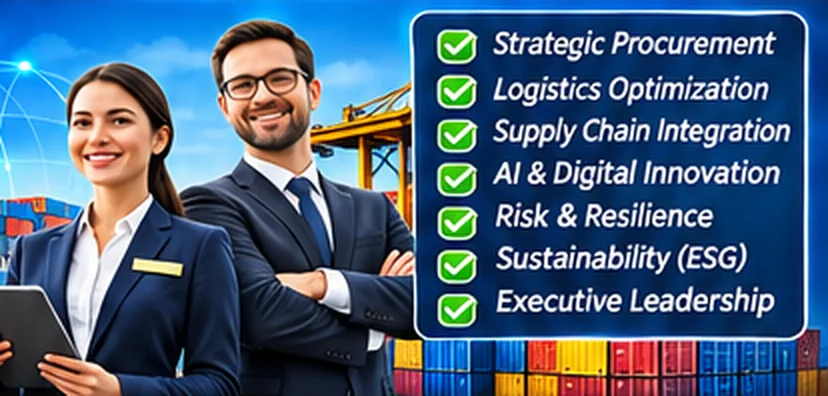
  • Strengthen procurement strategy, supplier management, and contract performance.
  • Optimize logistics, transportation, warehousing, and distribution.
  • Integrate end-to-end supply chain planning and operations.
  • Apply AI, analytics, and automation to improve performance.
  • Enhance risk management, resilience, and business continuity.
  • Advance sustainable and responsible supply chain practices.
  • Build executive leadership and lead organizational transformation.

Program at a Glance

Program TitleExecutive Diploma in Procurement, Logistics & Supply Chain Leadership
DesignationEDPLSCL®
Awarding OrganizationAAPSCM®
Program LevelAdvanced Executive Diploma
Curriculum8 comprehensive executive modules
Learning ApproachExecutive instruction, AI demonstrations, RPA exercises, workflow simulations, operational case studies, and capstone development
Virtual Instructor-Led Training5 days, 2 hours daily
Total Virtual Instruction10 hours
Self-Paced LearningFlexible independent study with complete complimentary digital course materials
In-Seat Executive Training4 days, scheduled cohort-based instruction
In-Seat LocationAAPSCM® Training Center, Dallas, Texas, USA
Final AssessmentMandatory Applied Executive Capstone Project
Minimum Capstone Passing Score70%
Virtual Training Fee$2,500 USD
Self-Paced Fee$800 USD
In-Seat Training Fee$3,000 USD
International ParticipationInternational applicants welcome
Professional FocusStrategic procurement, logistics optimization, integrated supply chain leadership, AI and analytics, risk management, sustainability, and enterprise transformation

2. Why This Executive Diploma MattersKey Reasons to Advance Your Procurement, Logistics & Supply Chain Leadership

Drive Strategic Value

Align procurement, logistics, and supply chain operations with business goals.

Improve Operational Efficiency

Reduce costs, optimize resources, and strengthen service performance.

Enhance Supply Chain Resilience

Identify risks, build continuity plans, and strengthen response capability.

Apply AI & Digital Innovation

Use AI, analytics, and automation to improve planning, sourcing, and logistics.

Advance Sustainability & ESG

Integrate responsible sourcing and environmental performance.

Strengthen Governance & Compliance

Ensure ethical, compliant, and accountable supply chain practices.

Develop Executive Leadership

Lead change, drive transformation, and deliver measurable results.

1 / 7Swipe or use the arrows →

Program Video

3. Program Learning Outcomes

By the end of the program, you will be able to:

  • Develop and execute procurement strategies that drive cost, value, and supplier performance.
  • Optimize logistics, transportation, warehousing, and distribution operations.
  • Integrate end-to-end supply chain planning and operational execution.
  • Apply AI, analytics, and automation to improve decision-making and visibility.
  • Assess and mitigate supply chain risks and build operational resilience.
  • Implement sustainable and responsible supply chain practices (ESG).
  • Evaluate financial performance and develop data-driven improvement initiatives.
  • Lead transformation initiatives and deliver measurable business value.

4. Program Curriculum – 8 Comprehensive ModulesA Strategic, End-to-End Executive Curriculum

Module 1Strategic Procurement Leadership & Enterprise Value Creation
Module 2Logistics Strategy, Transportation & Distribution Excellence
Module 3Integrated Supply Chain Planning, Inventory & Operational Excellence
Module 4AI, Digital Supply Chains & Intelligent Automation
Module 5Supply Chain Risk, Resilience & Global Trade Management
Module 6Sustainable Procurement, ESG & Responsible Supply Chain Governance
Module 7Supply Chain Financial Performance, Analytics & Strategic Decision-Making
Module 8Executive Supply Chain Leadership, Strategy & Enterprise Transformation
1 / 8Swipe or use the arrows →

5. Knowledge DomainCore Competencies You Will Gain

Procurement Strategy
Logistics Management
Supply Chain Integration
AI & Analytics
Risk & Resilience
Sustainability (ESG)
Executive Leadership
1 / 7Swipe or use the arrows →

6. Global Standards & Frameworks

ISO 20400Sustainable Procurement
ISO 9001Quality Management
ISO 28000Supply Chain Security
ISO 31000Risk Management
ISO/IEC 27001Information Security
ISO/IEC 42001AI Management
1 / 6Swipe or use the arrows →
Optimize Total Cost
Improve Service Performance
Build Resilient Supply Chains
Achieve Sustainability (ESG)
Drive Transformation
Advance Your Leadership
Advance Your Career in Procurement, Logistics & Supply Chain Leadership with AAPSCM®

More about EDPLSCL® Executive Diploma

The complete program information, in one place. Swipe sideways or use the arrows to browse each topic.

1
Program Overview

Develop the Strategic Expertise to Lead Modern Procurement, Logistics, and Global Supply Chains

The Executive Diploma in Procurement, Logistics & Supply Chain Leadership (EDPLSCL®) is an advanced, practitioner-focused executive education program designed to prepare professionals for strategic leadership responsibilities across procurement, logistics, transportation, warehousing, inventory management, supply chain operations, and enterprise transformation.

In today's increasingly interconnected and technology-driven global economy, organizations require leaders who can integrate procurement strategy, supplier relationships, logistics networks, operational performance, risk management, sustainability, and emerging technologies into a unified supply chain management framework.

The EDPLSCL® program addresses these demands by combining executive leadership principles with advanced procurement practices, logistics optimization, supply chain analytics, digital transformation, artificial intelligence (AI), and operational governance.

Participants develop the knowledge and practical competencies needed to manage complex supply chain environments, improve operational efficiency, strengthen supplier performance, optimize transportation and distribution networks, and lead organizational initiatives that generate measurable business value.

Unlike programs that examine procurement, logistics, and supply chain management as separate functions, EDPLSCL® emphasizes end-to-end enterprise integration, enabling participants to understand how decisions in one functional area influence costs, service quality, resilience, profitability, and overall organizational performance.

The program integrates executive instruction, real-world business cases, AI demonstrations, robotic process automation (RPA) exercises, workflow simulations, operational analysis, and an applied executive capstone project.

Through this learning experience, participants develop the strategic, analytical, operational, and leadership capabilities necessary to support modern organizations operating across domestic and international markets.

The EDPLSCL® Executive Advantage

The program emphasizes five interconnected dimensions of supply chain leadership:

  • Strategic Procurement Excellence: Strengthening sourcing decisions, supplier relationships, category management, contract performance, and procurement value creation.
  • Intelligent Logistics Management: Optimizing transportation, distribution, warehousing, inventory control, and logistics service delivery.
  • Integrated Supply Chain Strategy: Aligning planning, sourcing, operations, logistics, and customer fulfillment with enterprise objectives.
  • Digital Innovation and Operational Intelligence: Applying AI, predictive analytics, automation, and digital platforms to improve decision-making and operational performance.
  • Executive Leadership and Organizational Transformation: Developing governance, risk management, sustainability, change leadership, and performance improvement capabilities.

EDPLSCL® prepares professionals to move beyond functional management and become strategic leaders capable of designing, integrating, and transforming complex procurement, logistics, and supply chain operations.

2
Program at a Glance
Program ComponentDetails
Program TitleExecutive Diploma in Procurement, Logistics & Supply Chain Leadership
DesignationEDPLSCL®
Awarding OrganizationAAPSCM®
Program LevelAdvanced Executive Diploma
Curriculum8 comprehensive executive modules
Learning ApproachExecutive instruction, AI demonstrations, RPA exercises, workflow simulations, operational case studies, and capstone development
Virtual Instructor-Led Training5 days, 2 hours daily
Total Virtual Instruction10 hours
Self-Paced LearningFlexible independent study with complete complimentary digital course materials
In-Seat Executive Training4 days, scheduled cohort-based instruction
In-Seat LocationAAPSCM® Training Center, Dallas, Texas, USA
Final AssessmentMandatory Applied Executive Capstone Project
Minimum Capstone Passing Score70%
Virtual Training Fee$2,500 USD
Self-Paced Fee$800 USD
In-Seat Training Fee$3,000 USD
International ParticipationInternational applicants welcome
Professional FocusStrategic procurement, logistics optimization, integrated supply chain leadership, AI and analytics, risk management, sustainability, and enterprise transformation
3
Why Choose the EDPLSCL® Executive Diploma?

Build the Leadership Capabilities That Modern Supply Chains Demand

Global procurement and supply chain operations are undergoing substantial transformation. Organizations face increasing pressure to control costs, strengthen resilience, improve delivery performance, manage supplier risks, implement intelligent technologies, and respond to changing customer expectations.

EDPLSCL® provides a structured pathway for professionals seeking to strengthen their leadership capabilities and contribute more effectively to organizational performance.

3.1 Strengthen Strategic Procurement Leadership

Develop the ability to transform procurement from a primarily transactional activity into a strategic function that supports enterprise growth, cost optimization, supplier innovation, and long-term value creation.

Participants explore strategic sourcing, category management, supplier relationship management, procurement governance, negotiation, and contract performance.

3.2 Improve Logistics and Distribution Performance

Build advanced capabilities in transportation management, distribution planning, warehouse operations, inventory control, and logistics network optimization.

Learn how to evaluate logistics performance, identify operational inefficiencies, and implement practical improvements that enhance service delivery while managing costs.

3.3 Integrate End-to-End Supply Chain Operations

Understand the relationships among procurement, demand planning, inventory management, manufacturing, logistics, distribution, and customer fulfillment.

Develop strategies for improving coordination, information visibility, and decision-making across the supply chain.

3.4 Apply Artificial Intelligence and Digital Technologies

Explore practical applications of AI, machine learning, predictive analytics, RPA, Internet of Things (IoT), and intelligent supply chain platforms.

Learn how these technologies support demand forecasting, procurement automation, inventory optimization, transportation planning, supplier intelligence, and risk monitoring.

3.5 Strengthen Risk Management and Business Resilience

Develop capabilities to identify, evaluate, and respond to supplier disruptions, transportation constraints, geopolitical uncertainty, cybersecurity threats, and operational vulnerabilities.

Explore business continuity planning, scenario analysis, supplier diversification, and resilience strategies.

3.6 Advance Sustainable and Responsible Supply Chains

Examine sustainable procurement, environmental performance, ethical sourcing, supplier accountability, and responsible logistics practices.

Learn how to incorporate sustainability and environmental, social, and governance (ESG) considerations into procurement and supply chain decisions.

3.7 Develop Executive Decision-Making Capabilities

Strengthen financial analysis, strategic planning, performance measurement, stakeholder engagement, cross-functional leadership, and organizational change management.

Participants learn to translate operational information into executive-level recommendations and measurable improvement initiatives.

3.8 Demonstrate Applied Executive Competence

Complete a mandatory Applied Executive Capstone Project that integrates procurement, logistics, supply chain strategy, analytics, governance, and leadership.

The capstone enables participants to demonstrate their ability to analyze an organizational challenge and develop a practical, evidence-based solution.

4
Who Should Enroll?

Designed for Current and Emerging Procurement, Logistics, and Supply Chain Leaders

The EDPLSCL® program is intended for experienced professionals, managers, executives, consultants, and high-potential individuals seeking broader strategic responsibilities.

Procurement and Sourcing Professionals

  • Procurement Managers and Directors
  • Strategic Sourcing Managers
  • Category Management Professionals
  • Purchasing and Contract Management Leaders
  • Supplier Relationship Managers
  • Procurement Transformation Specialists

Logistics and Transportation Professionals

  • Logistics Managers and Directors
  • Transportation and Distribution Managers
  • Freight and Transportation Operations Specialists
  • Warehouse and Inventory Managers
  • Distribution Center Leaders
  • Third-Party Logistics (3PL) Managers

Supply Chain and Operations Professionals

  • Supply Chain Managers and Directors
  • Operations Managers
  • Demand and Supply Planning Professionals
  • Inventory Control Specialists
  • Supply Chain Analysts
  • Business Continuity and Operational Risk Professionals

Senior Executives and Business Leaders

  • Chief Procurement Officers
  • Chief Supply Chain Officers
  • Chief Operations Officers
  • Vice Presidents of Procurement and Supply Chain
  • General Managers
  • Business Transformation Directors

Consultants and Emerging Leaders

  • Supply Chain Consultants
  • Procurement and Logistics Advisors
  • Digital Transformation Professionals
  • Business Analysts
  • Project and Program Managers
  • Professionals preparing for senior leadership responsibilities

The program is also suitable for professionals transitioning from specialized procurement, logistics, or operational roles into broader supply chain leadership positions.

5
Program Learning Outcomes

What You Will Be Able to Accomplish

Upon successful completion of the EDPLSCL® program, participants will be able to demonstrate competencies across eight executive leadership areas.

A. Strategic Procurement and Supplier Management

  • Develop procurement strategies aligned with organizational priorities, financial objectives, and operational requirements.
  • Apply strategic sourcing and category management principles to improve purchasing decisions.
  • Evaluate supplier capabilities using performance indicators, risk assessments, and commercial analysis.
  • Design supplier relationship management frameworks that support collaboration, accountability, and innovation.
  • Strengthen contract management, negotiation preparation, and supplier performance governance.

B. Logistics and Distribution Optimization

  • Analyze transportation and distribution networks to identify efficiency and service improvement opportunities.
  • Evaluate transportation modes, freight cost structures, routing strategies, and logistics service requirements.
  • Develop warehouse and distribution improvement strategies.
  • Apply inventory control principles to support product availability and cost management.
  • Establish logistics performance indicators for transportation, warehousing, and distribution operations.

C. Integrated Supply Chain Planning

  • Align procurement, demand planning, inventory, operations, and logistics activities.
  • Apply supply chain planning frameworks to improve coordination and resource utilization.
  • Evaluate demand variability, inventory requirements, and operational constraints.
  • Develop integrated planning approaches that improve visibility and responsiveness.
  • Support enterprise-wide decisions through cross-functional collaboration.

D. Artificial Intelligence and Supply Chain Analytics

  • Identify practical applications of AI and machine learning in procurement and supply chain management.
  • Apply predictive analytics concepts to demand forecasting, inventory optimization, and supplier performance.
  • Evaluate automation opportunities across procurement and logistics workflows.
  • Interpret supply chain dashboards and operational performance data.
  • Develop recommendations for responsible technology adoption and digital transformation.

E. Supply Chain Risk and Resilience

  • Identify operational, financial, supplier, logistics, geopolitical, and technology-related risks.
  • Develop supplier and logistics risk assessment frameworks.
  • Evaluate business continuity and contingency planning strategies.
  • Apply scenario analysis to supply chain disruptions.
  • Recommend resilience measures that strengthen operational continuity.

F. Sustainability and Responsible Operations

  • Integrate sustainable procurement principles into supplier selection and sourcing strategies.
  • Evaluate environmental considerations in transportation, warehousing, and distribution.
  • Apply ethical sourcing and supplier accountability practices.
  • Develop sustainability performance indicators.
  • Align procurement and supply chain activities with organizational ESG priorities.

G. Financial and Operational Performance

  • Evaluate total cost of ownership and cost-to-serve considerations.
  • Develop procurement and logistics performance scorecards.
  • Assess opportunities for cost savings, productivity improvements, and working capital optimization.
  • Evaluate investment proposals for supply chain technology and operational improvements.
  • Translate operational data into executive-level business recommendations.

H. Executive Leadership and Transformation

  • Lead cross-functional procurement and supply chain improvement initiatives.
  • Develop organizational transformation roadmaps.
  • Apply stakeholder engagement and change management techniques.
  • Build performance accountability and continuous improvement practices.
  • Present strategic recommendations to senior management using evidence-based analysis.
6
Comprehensive Executive Curriculum

Eight Advanced Executive Modules

The EDPLSCL® curriculum integrates procurement, logistics, supply chain management, digital innovation, risk management, and executive leadership into eight interconnected learning modules.

Each module combines conceptual knowledge with practical business applications, industry scenarios, executive discussion, and applied exercises.

Module 1: Strategic Procurement Leadership & Enterprise Value Creation

Building Procurement as a Strategic Business Function

This module establishes the strategic role of procurement in organizational performance, profitability, operational resilience, and enterprise competitiveness.

Participants examine how procurement leaders develop sourcing strategies, manage supplier relationships, influence organizational decisions, and create measurable business value.

Submodule 1.1: Strategic Procurement Management and Governance

  • Evolution of procurement from transactional purchasing to strategic value creation.
  • Procurement's contribution to enterprise strategy and financial performance.
  • Procurement organizational structures and operating models.
  • Procurement policies, governance, accountability, and ethical decision-making.
  • Centralized, decentralized, and hybrid procurement models.
  • Procurement maturity assessments and leadership priorities.

Submodule 1.2: Strategic Sourcing, Category Management, and Supplier Excellence

  • Strategic sourcing frameworks and sourcing lifecycle management.
  • Category segmentation and category strategy development.
  • Spend analysis and purchasing opportunity identification.
  • Supplier qualification, selection, and performance evaluation.
  • Supplier relationship management and supplier development.
  • Negotiation preparation, commercial evaluation, and contract performance.

Submodule 1.3: Procurement Financial Intelligence and Value Optimization

  • Total Cost of Ownership (TCO) analysis.
  • Should-cost modeling and supplier cost evaluation.
  • Procurement savings measurement and cost avoidance.
  • Supplier value contribution and performance scorecards.
  • Procurement budgeting and financial accountability.
  • Executive procurement reporting and performance improvement.

Practical Executive Exercise: Develop a strategic procurement improvement plan for an organization, including a sourcing opportunity assessment, supplier performance analysis, and measurable procurement KPIs.

Expected Competency: Ability to develop procurement strategies that improve cost effectiveness, supplier performance, governance, and organizational value.

Module 2: Logistics Strategy, Transportation & Distribution Excellence

Optimizing the Movement of Goods, Information, and Resources

Effective logistics leadership requires the ability to coordinate transportation, distribution, inventory movement, logistics service providers, and customer delivery requirements.

This module provides practical frameworks for improving logistics performance while balancing cost, reliability, speed, service quality, and operational risk.

Submodule 2.1: Strategic Logistics and Transportation Management

  • Role of logistics in enterprise supply chain performance.
  • Transportation mode selection and network planning.
  • Freight management and transportation cost analysis.
  • Domestic and international transportation considerations.
  • Carrier selection and transportation service agreements.
  • Transportation management systems and digital freight visibility.

Submodule 2.2: Warehouse, Inventory, and Distribution Operations

  • Warehouse layout, material flow, and storage optimization.
  • Inventory classification and replenishment strategies.
  • Warehouse management systems and inventory visibility.
  • Picking, packing, shipping, and order fulfillment.
  • Distribution center performance and capacity planning.
  • Inventory accuracy, cycle counting, and loss prevention.

Submodule 2.3: Logistics Network Optimization and Performance Measurement

  • Distribution network design and facility location considerations.
  • Transportation routing and delivery scheduling.
  • Logistics outsourcing and 3PL performance management.
  • Cost-to-serve analysis and service-level performance.
  • Last-mile delivery challenges and optimization.
  • Logistics KPIs, dashboards, and continuous improvement.

Practical Executive Exercise: Evaluate a transportation and distribution network and recommend improvements to cost, delivery performance, inventory movement, and logistics visibility.

Expected Competency: Ability to lead logistics improvement initiatives and make informed transportation, warehousing, and distribution decisions.

Module 3: Integrated Supply Chain Planning, Inventory & Operational Excellence

Connecting Procurement, Planning, Operations, and Customer Fulfillment

This module explores the management of supply chains as interconnected systems rather than isolated departments.

Participants examine how demand variability, procurement decisions, production constraints, inventory policies, and logistics capabilities influence enterprise performance.

Submodule 3.1: End-to-End Supply Chain Strategy and Integration

  • Supply chain structures and operating models.
  • Relationships among suppliers, manufacturers, distributors, and customers.
  • Cross-functional coordination and information sharing.
  • Supply chain segmentation and operating priorities.
  • Supply chain performance drivers and tradeoffs.
  • Integrated business planning and enterprise alignment.

Submodule 3.2: Demand Planning, Supply Planning, and Inventory Optimization

  • Demand forecasting principles and forecasting accuracy.
  • Sales and Operations Planning (S&OP).
  • Supply and capacity planning.
  • Safety stock, reorder points, and inventory policies.
  • Inventory turnover and working capital considerations.
  • Demand variability and supply chain responsiveness.

Submodule 3.3: Operational Excellence and Continuous Improvement

  • Lean supply chain management.
  • Process mapping and value stream analysis.
  • Waste reduction and operational efficiency.
  • Root cause analysis and problem-solving frameworks.
  • Continuous improvement initiatives.
  • Performance benchmarking and operational scorecards.

Practical Executive Exercise: Develop an integrated supply chain planning scenario that aligns demand forecasts, procurement requirements, inventory levels, and logistics capacity.

Expected Competency: Ability to improve supply chain coordination, inventory performance, planning accuracy, and operational effectiveness.

Module 4: Artificial Intelligence, Digital Supply Chains & Intelligent Automation

Applying Emerging Technologies to Procurement, Logistics, and Supply Chain Decisions

Artificial intelligence and digital technologies are changing how organizations forecast demand, evaluate suppliers, manage inventory, optimize logistics, and monitor operational performance.

This module focuses on the practical application of intelligent technologies and the leadership considerations associated with their implementation.

Submodule 4.1: AI, Machine Learning, and Predictive Supply Chain Analytics

  • Foundations of AI and machine learning in supply chain management.
  • Predictive demand forecasting and inventory analytics.
  • Supplier performance and risk prediction.
  • Transportation and logistics analytics.
  • AI-supported procurement decision-making.
  • Data quality, model limitations, and human oversight.

Submodule 4.2: RPA, Intelligent Workflows, and Supply Chain Automation

  • Introduction to robotic process automation.
  • Procurement workflow automation and purchase order processing.
  • Intelligent invoice matching and exception handling.
  • Supplier onboarding and document automation.
  • Warehouse automation and robotics applications.
  • Process selection and automation readiness assessment.

Submodule 4.3: Digital Platforms, IoT, and Supply Chain Visibility

  • Enterprise Resource Planning (ERP) integration.
  • Procurement and supplier management platforms.
  • Warehouse Management Systems (WMS).
  • Transportation Management Systems (TMS).
  • IoT-enabled shipment and inventory tracking.
  • Digital twins, real-time dashboards, and operational control towers.
  • Cybersecurity, responsible AI, and technology governance.

Practical Executive Exercise: Design an AI-enabled supply chain improvement use case incorporating predictive analytics, workflow automation, and a management dashboard.

Expected Competency: Ability to evaluate and recommend digital technologies that improve visibility, decision-making, efficiency, and supply chain performance.

Module 5: Supply Chain Risk, Resilience & Global Trade Management

Building Supply Chains That Can Anticipate, Respond to, and Recover from Disruptions

Global supply chains operate in environments influenced by economic uncertainty, geopolitical events, transportation disruptions, supplier failures, cybersecurity threats, and regulatory requirements.

This module develops the analytical and leadership competencies needed to identify vulnerabilities and strengthen operational continuity.

Submodule 5.1: Enterprise Supply Chain Risk Intelligence

  • Strategic and operational supply chain risks.
  • Supplier financial and performance risks.
  • Geopolitical and international trade disruptions.
  • Transportation and infrastructure vulnerabilities.
  • Cybersecurity and digital supply chain risks.
  • Risk identification, probability, impact, and prioritization.

Submodule 5.2: Business Continuity and Supply Chain Resilience

  • Business continuity planning principles.
  • Supplier diversification and alternative sourcing.
  • Inventory buffers and capacity contingency strategies.
  • Logistics disruption response planning.
  • Scenario analysis and stress testing.
  • Crisis communications and recovery planning.

Submodule 5.3: International Trade, Compliance, and Supply Chain Security

  • International procurement and logistics considerations.
  • Customs documentation and trade compliance fundamentals.
  • Incoterms and international shipping responsibilities.
  • Import and export controls.
  • Supply chain security and cargo protection.
  • Global trade risk monitoring and regulatory accountability.

Practical Executive Exercise: Develop a supply chain risk register and business continuity response plan for a simulated supplier disruption or international logistics crisis.

Expected Competency: Ability to establish risk mitigation strategies and improve organizational preparedness, continuity, and supply chain resilience.

Module 6: Sustainable Procurement, ESG & Responsible Supply Chain Governance

Integrating Environmental, Social, and Governance Priorities into Supply Chain Leadership

Sustainable supply chain management requires organizations to consider environmental performance, responsible sourcing, labor practices, ethical conduct, regulatory expectations, and long-term operational sustainability.

This module explores how procurement and supply chain leaders can integrate responsible business practices into strategic and operational decisions.

Submodule 6.1: Sustainable Procurement and Ethical Sourcing

  • Principles of sustainable procurement.
  • Responsible supplier selection and evaluation.
  • Supplier codes of conduct and ethical procurement.
  • Human rights and labor considerations in supply chains.
  • Sustainable sourcing strategies.
  • Supplier sustainability performance assessment.

Submodule 6.2: Environmental Performance and Sustainable Logistics

  • Transportation emissions and logistics sustainability.
  • Energy efficiency in warehousing and distribution.
  • Waste reduction and resource optimization.
  • Circular economy principles.
  • Reverse logistics and product recovery.
  • Environmental performance measurement.

Submodule 6.3: ESG Governance, Compliance, and Reporting

  • ESG considerations in procurement and supply chain management.
  • Supply chain transparency and traceability.
  • Supplier ESG scorecards and monitoring.
  • Sustainability data collection and reporting.
  • Responsible AI and data governance.
  • Continuous improvement in responsible supply chain practices.

Practical Executive Exercise: Develop a sustainable procurement and logistics improvement framework incorporating supplier ESG indicators, environmental performance measures, and responsible sourcing recommendations.

Expected Competency: Ability to integrate sustainability, ethics, governance, and supplier accountability into procurement and supply chain strategies.

Module 7: Supply Chain Financial Performance, Analytics & Strategic Decision-Making

Turning Supply Chain Data into Measurable Business Results

Executive supply chain leadership requires the ability to evaluate operational performance through financial, commercial, and strategic perspectives.

This module develops the competencies needed to interpret financial information, evaluate investment alternatives, and design performance measurement systems.

Submodule 7.1: Procurement and Supply Chain Financial Management

  • Procurement budgeting and expenditure management.
  • Logistics cost structures.
  • Total Cost of Ownership.
  • Inventory carrying costs.
  • Working capital and cash-to-cash cycle considerations.
  • Cost reduction and value improvement initiatives.

Submodule 7.2: Business Intelligence and Supply Chain Performance Analytics

  • Supply chain KPI design.
  • Procurement savings and supplier performance metrics.
  • Transportation and warehouse performance indicators.
  • Inventory turnover and order fulfillment metrics.
  • Executive dashboards and business intelligence reporting.
  • Data visualization and operational decision support.

Submodule 7.3: Investment Evaluation and Strategic Business Cases

  • Return on Investment (ROI).
  • Cost-benefit analysis.
  • Technology investment evaluation.
  • Automation business cases.
  • Financial and operational scenario analysis.
  • Executive recommendations and performance accountability.

Practical Executive Exercise: Develop a supply chain performance dashboard and business case for an improvement initiative involving procurement, logistics, inventory, or digital technology.

Expected Competency: Ability to evaluate supply chain performance, justify operational investments, and present financially informed recommendations.

Module 8: Executive Supply Chain Leadership, Strategy & Enterprise Transformation

Leading People, Processes, Technology, and Organizational Change

The final module integrates the strategic, operational, analytical, and governance competencies developed throughout the program.

Participants examine the leadership responsibilities associated with managing complex procurement and supply chain functions, implementing organizational change, and delivering enterprise-wide transformation.

Submodule 8.1: Executive Leadership and Strategic Supply Chain Governance

  • Executive leadership principles.
  • Strategic planning and organizational alignment.
  • Procurement and supply chain governance.
  • Decision rights and accountability.
  • Cross-functional leadership.
  • Executive stakeholder engagement.

Submodule 8.2: Organizational Transformation and Change Management

  • Digital and operational transformation frameworks.
  • Organizational readiness assessments.
  • Change management planning.
  • Workforce capability development.
  • Communication and stakeholder engagement.
  • Technology adoption and performance improvement.

Submodule 8.3: Enterprise Strategy, Innovation, and Continuous Improvement

  • Developing integrated supply chain transformation roadmaps.
  • Procurement and logistics innovation strategies.
  • Strategic performance measurement.
  • Transformation project governance.
  • Continuous improvement and organizational learning.
  • Executive reporting and strategic recommendations.

Practical Executive Exercise: Prepare an integrated procurement, logistics, and supply chain transformation roadmap that identifies strategic priorities, operational improvements, technology opportunities, governance responsibilities, and measurable performance outcomes.

Expected Competency: Ability to lead enterprise procurement and supply chain transformation initiatives through effective strategy, governance, communication, and performance management.

7
Mandatory Applied Executive Capstone Project

Integrated Procurement, Logistics & Supply Chain Leadership Transformation Project

Demonstrate Your Ability to Solve Complex Enterprise Supply Chain Challenges

The EDPLSCL® program concludes with a Mandatory Applied Executive Capstone Project designed to assess participants' ability to integrate strategic procurement, logistics management, supply chain planning, digital innovation, risk management, sustainability, and executive leadership into a practical organizational solution.

The capstone emphasizes applied decision-making, evidence-based recommendations, strategic analysis, and implementation planning.

Participants may select an actual organization, an approved business case, or a simulated enterprise scenario.

Capstone Project Objectives

Participants are expected to demonstrate the ability to:

  • Evaluate an organization's procurement, logistics, and supply chain operating environment.
  • Identify strategic, operational, financial, and technology-related challenges.
  • Develop integrated improvement recommendations.
  • Apply appropriate analytical tools and management frameworks.
  • Incorporate AI and digital transformation opportunities.
  • Evaluate supply chain risks and sustainability considerations.
  • Design an actionable implementation roadmap.
  • Establish measurable performance indicators and executive reporting mechanisms.

Required Capstone Components

Component 1: Organizational and Supply Chain Profile

Describe the organization, its business model, supply chain structure, operating environment, and strategic priorities.

Component 2: Procurement Performance Assessment

Evaluate procurement processes, sourcing strategies, supplier performance, purchasing costs, and governance practices.

Component 3: Logistics and Distribution Assessment

Analyze transportation, warehousing, inventory movement, distribution networks, and logistics performance.

Component 4: Integrated Supply Chain Performance Analysis

Identify coordination challenges, planning inefficiencies, operational bottlenecks, and improvement opportunities.

Component 5: Digital Transformation and AI Opportunities

Recommend appropriate applications of AI, analytics, automation, RPA, or digital platforms.

Component 6: Risk, Resilience, and Sustainability Strategy

Develop risk mitigation recommendations, business continuity considerations, and responsible supply chain practices.

Component 7: Strategic Implementation Roadmap

Present implementation phases, resource requirements, stakeholder responsibilities, milestones, and change management priorities.

Component 8: Executive Performance Measurement Framework

Develop KPIs, financial considerations, expected benefits, monitoring procedures, and executive reporting recommendations.

Required Capstone Deliverables

Participants must submit:

  • An executive-level written transformation report.
  • A procurement, logistics, and supply chain performance assessment.
  • A strategic improvement and implementation roadmap.
  • A performance measurement framework with relevant KPIs.
  • Supporting analytical evidence, diagrams, or dashboards, as appropriate.
  • An executive presentation summarizing findings and recommendations.

Capstone Evaluation Rubric

Assessment AreaMaximum Points
Organizational analysis and problem definition15
Procurement strategy and supplier management recommendations15
Logistics and integrated supply chain analysis15
AI, analytics, and digital transformation integration15
Risk, resilience, sustainability, and governance10
Implementation roadmap and change management15
Financial justification, KPIs, and measurable outcomes10
Executive presentation and professional communication5
Total100

Minimum Passing Score: 70%

Participants must achieve at least 70 out of 100 points to satisfy the mandatory capstone assessment requirement.

The same minimum assessment standard applies across the approved training pathways.

8
Training Delivery Options

Flexible Executive Education for Working Professionals and International Participants

EDPLSCL® offers three learning pathways designed to accommodate professional schedules, organizational requirements, and individual learning preferences.

Option 1: Virtual Instructor-Led Executive Training (VILT)

Live Executive Instruction | Interactive Learning | Global Accessibility

The Virtual Instructor-Led Training pathway provides live, structured instruction delivered by qualified facilitators through an online learning environment.

Participants engage in executive discussions, AI demonstrations, workflow simulations, operational case studies, and guided capstone preparation.

Training Structure

  • Duration: 7 training days.
  • Daily instruction: 2 hours.
  • Total virtual instruction: 10 hours.
  • Delivery: Live online instructor-led sessions.
  • Curriculum: Eight comprehensive executive modules.
  • Learning resources: Digital course materials and practical exercises.
  • Final assessment: Mandatory Applied Executive Capstone Project.
  • Minimum passing score: 70%.

Key Benefits

  • Participate from anywhere with reliable internet access.
  • Engage directly with instructors and fellow professionals.
  • Examine real-world procurement, logistics, and supply chain scenarios.
  • Develop practical executive decision-making capabilities.
  • Receive structured guidance for capstone development.

Virtual Instructor-Led Training Fee: $2,500 USD

Option 2: Self-Paced Executive Learning

Flexible Study | Independent Progress | Complete Digital Learning Resources

The Self-Paced Learning pathway is designed for professionals who prefer independent study and the flexibility to complete learning activities according to their schedules.

Participants receive access to the digital learning materials supporting the eight-module curriculum.

Training Structure

  • Duration: Flexible independent study.
  • Learning mode: Self-directed.
  • Curriculum: Eight comprehensive executive modules.
  • Course materials: Complete complimentary digital course materials.
  • Learning activities: Independent case analysis, practical exercises, and applied learning.
  • Final assessment: Mandatory Applied Executive Capstone Project.
  • Minimum passing score: 70%.

Key Benefits

  • Study without fixed classroom attendance requirements.
  • Progress through the curriculum according to personal availability.
  • Access digital learning resources for independent preparation.
  • Apply program concepts to professional challenges.
  • Demonstrate competence through the mandatory executive capstone.

Self-Paced Learning Fee: $800 USD

Option 3: In-Seat Executive Training

Immersive Learning | Executive Workshops | Practical Applications

The In-Seat Executive Training pathway provides a structured classroom experience for professionals seeking direct interaction, collaborative learning, and concentrated executive development.

Participants engage in instructor-led workshops, operational simulations, case discussions, and applied exercises.

Training Structure

  • Duration: 4 training days.
  • Delivery: Scheduled cohort-based classroom instruction.
  • Location: AAPSCM® Training Center, Dallas, Texas, USA.
  • Curriculum: Eight comprehensive executive modules.
  • Learning activities: Executive workshops, practical simulations, case studies, and collaborative exercises.
  • Final assessment: Mandatory Applied Executive Capstone Project.
  • Minimum passing score: 70%.

Key Benefits

  • Participate in immersive executive learning.
  • Collaborate with professionals from procurement, logistics, and supply chain functions.
  • Examine operational challenges through guided case studies.
  • Develop practical improvement strategies.
  • Build professional connections through cohort-based learning.

In-Seat Executive Training Fee: $3,000 USD

9
Program Fees and Payment Structure

Invest in Your Executive Leadership Development

AAPSCM® offers three training options with clearly defined program fees.

Training OptionDurationDelivery FormatProgram Fee
Virtual Instructor-Led Training5 days × 2 hours (10 hours)Live online executive instruction$2,500 USD
Self-Paced LearningFlexibleIndependent study with complimentary digital course materials$800 USD
In-Seat Executive Training4 daysScheduled cohort-based training in Dallas, Texas$3,000 USD

What the Program Provides

Depending on the selected training pathway, participants receive:

  • Access to the eight-module executive curriculum.
  • Relevant instructional or self-study learning resources.
  • Procurement, logistics, and supply chain case studies.
  • AI and digital transformation learning activities.
  • Practical analytical and operational exercises.
  • Applied Executive Capstone Project requirements and evaluation.
  • Executive Diploma award upon successful completion of all applicable requirements.

Corporate and Group Training

Organizations seeking to develop procurement, logistics, or supply chain leadership capabilities across multiple employees may request customized corporate training arrangements.

Corporate training can emphasize organizational priorities such as procurement improvement, logistics optimization, integrated planning, supplier performance, risk management, or digital transformation.

Contact AAPSCM® for corporate cohort scheduling, group participation, and customized training arrangements.

10
International Standards and Professional Frameworks

Globally Relevant Knowledge for Responsible Procurement and Supply Chain Leadership

The EDPLSCL® curriculum incorporates concepts and management practices associated with relevant international standards and professional frameworks.

ISO 20400 — Sustainable Procurement

Supports the integration of sustainability principles into procurement strategy, supplier selection, and responsible sourcing decisions.

ISO 9001 — Quality Management Systems

Provides a framework for process consistency, customer focus, performance evaluation, and continuous improvement.

ISO 28000 — Supply Chain Security Management Systems

Addresses security management considerations associated with supply chain operations, logistics, and organizational risk.

ISO 31000 — Risk Management Guidelines

Provides principles and guidance for identifying, evaluating, and managing organizational risks.

ISO/IEC 27001 — Information Security Management Systems

Addresses information security governance and protection of sensitive operational and business information.

ISO/IEC 42001 — Artificial Intelligence Management Systems

Provides a management system framework for responsible organizational development, deployment, and oversight of AI.

ISO 14001 — Environmental Management Systems

Supports environmental management principles relevant to logistics, resource efficiency, and sustainable operations.

ISO 22301 — Business Continuity Management Systems

Provides a framework for organizational preparedness, continuity planning, and recovery from disruptions.

Standards Alignment Statement: References to international standards describe the program's educational and competency alignment. They do not constitute claims that the diploma or AAPSCM® has been independently accredited, certified, or endorsed by the organizations responsible for those standards.

11
Executive Diploma Award and Professional Recognition

Demonstrate Your Commitment to Procurement, Logistics, and Supply Chain Leadership

Upon successfully completing the prescribed curriculum and achieving the minimum passing score on the mandatory Applied Executive Capstone Project, eligible participants are awarded:

Executive Diploma in Procurement, Logistics & Supply Chain Leadership (EDPLSCL®)

Awarding Organization: American Association of Procurement, Supply Chain & Tourism Management (AAPSCM®)

The Executive Diploma recognizes successful completion of an advanced professional education program integrating strategic procurement, logistics management, supply chain planning, technology, governance, and executive leadership.

Professional Competencies Demonstrated

Successful participants will have demonstrated applied knowledge in:

  • Strategic procurement leadership.
  • Supplier and contract performance management.
  • Logistics and transportation optimization.
  • Inventory and distribution management.
  • Integrated supply chain planning.
  • Artificial intelligence and digital supply chain technologies.
  • Risk management and operational resilience.
  • Sustainability and responsible procurement.
  • Supply chain financial analysis.
  • Executive leadership and enterprise transformation.

The diploma supports professional development and provides evidence of applied executive learning. It does not independently guarantee employment, promotion, professional licensure, or recognition by a particular employer or regulator.

12
Career Pathways and Executive Opportunities

Prepare for Greater Responsibility Across Procurement, Logistics, and Supply Chain Functions

EDPLSCL® develops competencies relevant to a broad range of leadership, management, consulting, and transformation positions.

Executive Leadership Roles

  • Chief Procurement Officer (CPO)
  • Chief Supply Chain Officer (CSCO)
  • Chief Logistics Officer
  • Vice President of Procurement
  • Vice President of Supply Chain Management
  • Director of Global Supply Chain Operations

Procurement and Strategic Sourcing Leadership

  • Procurement Director
  • Strategic Sourcing Director
  • Category Management Director
  • Supplier Relationship Management Director
  • Procurement Excellence Manager
  • Procurement Transformation Leader

Logistics and Distribution Leadership

  • Logistics Director
  • Transportation Operations Director
  • Distribution Center Manager
  • Warehouse Operations Director
  • Global Logistics Manager
  • Logistics Network Optimization Manager

Supply Chain Strategy and Operations

  • Supply Chain Director
  • Supply Chain Planning Manager
  • Inventory Optimization Manager
  • Operations Excellence Manager
  • Integrated Business Planning Manager
  • Supply Chain Performance Manager

Digital Transformation and Consulting

  • Digital Supply Chain Transformation Manager
  • Procurement Technology Consultant
  • Supply Chain Analytics Manager
  • AI Supply Chain Strategy Consultant
  • Supply Chain Risk and Resilience Manager
  • Enterprise Supply Chain Transformation Advisor

The program provides relevant professional development for these career pathways; actual role eligibility depends on experience, qualifications, employer requirements, and other applicable criteria.

13
Industry Applications

Executive Competencies That Apply Across Multiple Industries

The EDPLSCL® program supports professionals working in diverse sectors that depend on efficient procurement, logistics, and supply chain operations.

Manufacturing and Industrial Operations

Improve supplier coordination, production material availability, inventory planning, and inbound and outbound logistics.

Retail and E-Commerce

Strengthen inventory visibility, fulfillment operations, distribution planning, supplier performance, and customer delivery.

Healthcare and Pharmaceuticals

Support procurement reliability, inventory control, critical supply availability, supplier governance, and distribution performance.

Energy, Oil, and Gas

Develop competencies in strategic sourcing, project logistics, contractor management, operational resilience, and supply chain risk.

Transportation and Logistics Services

Improve freight operations, transportation planning, warehouse performance, distribution networks, and logistics analytics.

Construction and Infrastructure

Strengthen project procurement, materials planning, supplier coordination, logistics scheduling, and contract performance.

Government and Public Sector

Support responsible procurement, supplier accountability, operational efficiency, transparency, and public-sector supply chain management.

Technology and Telecommunications

Improve technology sourcing, supplier management, service continuity, equipment logistics, and digital supply chain operations.

14
Key Performance Indicators and Business Value

Measure the Impact of Procurement, Logistics, and Supply Chain Leadership

The program emphasizes the importance of evaluating improvement initiatives through measurable performance indicators.

Participants explore how organizations can establish performance baselines, monitor operational progress, and assess the effectiveness of strategic decisions.

Procurement Performance Indicators

  • Procurement cost savings.
  • Spend under management.
  • Supplier on-time delivery.
  • Contract compliance.
  • Purchase order cycle time.
  • Supplier quality and performance.
  • Sourcing cycle time.

Logistics Performance Indicators

  • On-time delivery rate.
  • Transportation cost per shipment.
  • Freight cost as a percentage of sales.
  • Warehouse productivity.
  • Order fulfillment cycle time.
  • Distribution accuracy.
  • Logistics cost-to-serve.

Inventory and Supply Chain Indicators

  • Inventory turnover.
  • Days of inventory on hand.
  • Forecast accuracy.
  • Stockout frequency.
  • Order fill rate.
  • Cash-to-cash cycle time.
  • Supply chain response time.

Risk and Sustainability Indicators

  • Supplier risk exposure.
  • Business continuity readiness.
  • Supplier concentration risk.
  • Supply chain disruption recovery time.
  • Transportation emissions.
  • Sustainable sourcing performance.
  • Supplier ESG compliance.

Digital Transformation Indicators

  • Process automation rate.
  • Manual processing time reduction.
  • Data accuracy and completeness.
  • Technology adoption.
  • Process exception frequency.
  • Automation return on investment.
  • Operational dashboard utilization.

The objective is to help participants move beyond reporting activities toward identifying performance gaps, developing improvement strategies, and demonstrating measurable organizational value.

15
Frequently Asked Questions

What is the Executive Diploma in Procurement, Logistics & Supply Chain Leadership (EDPLSCL®)?

EDPLSCL® is an advanced executive education program developed and awarded by AAPSCM® to strengthen professional competencies in procurement strategy, logistics management, integrated supply chain operations, digital innovation, risk management, sustainability, and executive leadership.

How many modules are included in the program?

The program contains eight comprehensive executive modules covering strategic procurement, logistics, supply chain planning, AI and automation, risk and resilience, sustainability, financial performance, and executive transformation.

How long is the Virtual Instructor-Led Training?

The virtual training consists of five instructional days, with two hours of live instruction per day, totaling 10 hours.

Is self-paced learning available?

Yes. The Self-Paced Learning pathway provides flexible independent study with complete complimentary digital course materials.

Where is the in-seat training conducted?

The in-seat executive training is conducted at the AAPSCM® Training Center in Dallas, Texas, USA, through scheduled four-day cohorts.

Is an examination required?

The specified final assessment for EDPLSCL® is a Mandatory Applied Executive Capstone Project rather than a multiple-choice certification examination.

What is the minimum passing score?

Participants must achieve a minimum score of 70% on the Applied Executive Capstone Project.

Is the capstone mandatory for self-paced participants?

Yes. The mandatory capstone requirement applies to the program's learning pathways, including self-paced study.

What are the program fees?

The Virtual Instructor-Led Training fee is $2,500 USD, the Self-Paced Learning fee is $800 USD, and the In-Seat Executive Training fee is $3,000 USD.

Can international professionals enroll?

Yes. International applicants are welcome to participate, subject to applicable enrollment requirements and the selected training format.

Is the program suitable for professionals outside procurement?

Yes. The curriculum integrates procurement, logistics, supply chain operations, analytics, risk, and leadership, making it relevant to professionals from multiple operational and business disciplines.

What credential is awarded upon successful completion?

Successful participants receive the Executive Diploma in Procurement, Logistics & Supply Chain Leadership (EDPLSCL®), awarded by AAPSCM®.

Does the program include artificial intelligence?

Yes. AI, predictive analytics, intelligent automation, RPA, and digital supply chain technologies are integrated into the curriculum, with particular emphasis in Module 4.

16
Enrollment and Executive Education Registration

Take the Next Step Toward Executive Procurement and Supply Chain Leadership

Build Strategic Expertise. Strengthen Operational Performance. Lead Integrated Supply Chain Transformation.

The future of procurement, logistics, and supply chain management requires leaders who understand how to connect enterprise strategy, operational excellence, emerging technologies, risk management, and sustainable business practices.

The Executive Diploma in Procurement, Logistics & Supply Chain Leadership (EDPLSCL®) provides an advanced professional learning pathway for individuals seeking to strengthen these competencies and contribute to organizational performance.

Whether your goal is to improve procurement effectiveness, optimize logistics operations, strengthen supply chain resilience, implement intelligent technologies, or prepare for broader leadership responsibilities, EDPLSCL® offers a comprehensive executive education experience.

Select Your Preferred Training Pathway

Virtual Instructor-Led Training — $2,500 USD

5 days | 10 hours | Live online executive instruction

Self-Paced Executive Learning — $800 USD

Flexible study | Complete digital course materials

In-Seat Executive Training — $3,000 USD

4 days | AAPSCM® Training Center | Dallas, Texas, USA

Enrollment Calls to Action

[Enroll in EDPLSCL® Today]

[Request Corporate Executive Training]

[Download Executive Diploma Brochure]

[Contact an AAPSCM® Program Advisor]

Contact Information

American Association of Procurement, Supply Chain & Tourism Management (AAPSCM®)

Website: https://www.aapscm.org

Email: [email protected]

EDPLSCL® — Develop the Expertise to Lead Procurement, Logistics, and Supply Chains with Strategy, Intelligence, and Confidence.

1 / 16Swipe or use the arrows →