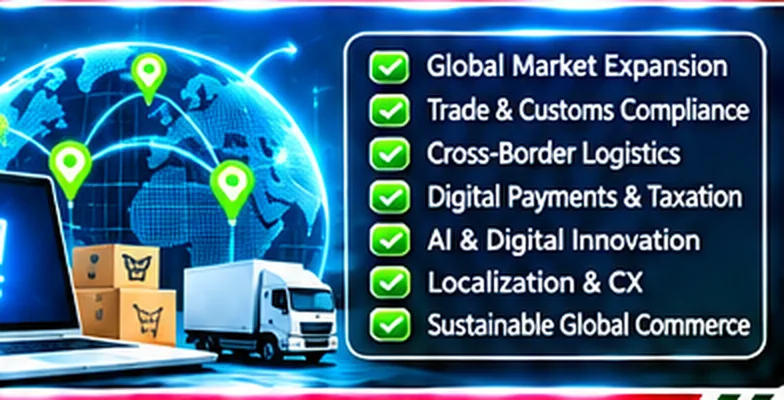
The CGCBE® curriculum progresses from international e-commerce strategy and market intelligence through customs compliance, global logistics, digital payments, customer localization, emerging technologies, risk management, and strategic international expansion.
Each module includes three submodules, defined learning objectives, practical applications, and an applied deliverable.
Module 1: Global E-Commerce Strategy and International Market Intelligence
Module Objective: Develop the ability to evaluate global digital commerce opportunities, assess international market conditions, and establish effective market entry strategies.
1.1 Foundations of Global Cross-Border E-Commerce
Examine the structure, evolution, and commercial characteristics of international digital commerce.
Key Topics:
- Cross-border e-commerce fundamentals.
- Business-to-consumer (B2C) international commerce.
- Business-to-business (B2B) digital trade.
- Direct-to-consumer international selling.
- Global online marketplaces.
- International platform business models.
- Digital trade ecosystems.
- Global commerce value chains.
- International customer expectations.
- Opportunities and limitations of cross-border commerce.
Practical Application: Compare international e-commerce business models and identify appropriate applications for a selected business.
1.2 International Market Research and Opportunity Assessment
Explore analytical methods for evaluating potential international markets.
Key Topics:
- International market segmentation.
- Market demand analysis.
- Country risk indicators.
- Consumer purchasing behavior.
- Competitive benchmarking.
- Digital infrastructure readiness.
- Internet and mobile commerce adoption.
- Payment accessibility.
- Logistics infrastructure.
- Market attractiveness scoring.
Practical Application: Develop a comparative international market assessment for three countries.
1.3 Global Market Entry and Expansion Strategy
Develop structured approaches to international market entry and business expansion.
Key Topics:
- Market entry models.
- Direct international selling.
- Global marketplace participation.
- Regional distributors and partners.
- Localized commerce operations.
- Market entry investment requirements.
- Strategic partnerships.
- Regulatory entry barriers.
- International growth sequencing.
- Market expansion performance indicators.
Practical Application: Prepare a market entry strategy for a selected international e-commerce opportunity.
Module Deliverable: Global E-Commerce Market Entry and Opportunity Assessment.
Module 2: International Trade Regulations, Customs, and Cross-Border Compliance
Module Objective: Develop practical knowledge of customs procedures, international trade documentation, regulatory requirements, and compliance risk management.
2.1 International Trade Frameworks and Regulatory Requirements
Examine the legal and institutional environment governing international trade and cross-border commercial transactions.
Key Topics:
- International trade governance.
- World Trade Organization principles.
- Regional trade agreements.
- Import and export requirements.
- Product restrictions.
- Export controls.
- Economic sanctions considerations.
- Customs authority responsibilities.
- Regulatory jurisdiction.
- Trade compliance governance.
Practical Application: Develop an international trade compliance checklist for a selected product and destination market.
2.2 Customs Classification, Valuation, and Trade Documentation
Explore the information and documentation required for international customs processing.
Key Topics:
- Harmonized System (HS) classification.
- National tariff schedules.
- Customs valuation.
- Country-of-origin determination.
- Preferential origin requirements.
- Commercial invoices.
- Packing lists.
- Transport documents.
- Import declarations.
- Customs brokerage coordination.
- Recordkeeping requirements.
Practical Application: Prepare a simulated customs documentation package and identify potential classification or valuation issues.
2.3 International Commercial Terms and Compliance Risk Management
Understand the relationship between commercial agreements, delivery responsibilities, customs procedures, and international trade risk.
Key Topics:
- Incoterms® 2020 rules.
- Buyer and seller responsibilities.
- Transfer of risk.
- Transportation cost allocation.
- Import and export clearance responsibilities.
- Customs duties and taxes.
- Product compliance.
- Trade documentation accuracy.
- Compliance audits.
- Corrective action procedures.
Practical Application: Evaluate international commercial scenarios using appropriate Incoterms® rules and compliance controls.
Module Deliverable: Cross-Border Trade Compliance and Customs Management Framework.
Module 3: Cross-Border Supply Chain, Logistics, and International Fulfillment
Module Objective: Develop the ability to coordinate international inventory, transportation, order fulfillment, and reverse logistics while managing costs and operational risks.
3.1 International Supply Chain and Inventory Management
Explore the relationship between international sourcing, digital sales demand, supplier coordination, and inventory availability.
Key Topics:
- Global supplier networks.
- International sourcing strategies.
- Inventory positioning.
- Regional distribution.
- Demand forecasting.
- Inventory replenishment.
- Safety stock considerations.
- Supplier lead times.
- Stock availability.
- Supply chain visibility.
Practical Application: Develop an inventory allocation strategy for an e-commerce company serving multiple international markets.
3.2 International Transportation and Cross-Border Fulfillment
Examine international transportation modes and fulfillment arrangements.
Key Topics:
- Air freight.
- Ocean freight.
- Road and rail transportation.
- International parcel delivery.
- Express courier services.
- Third-party logistics providers.
- Customs clearance coordination.
- Cross-border fulfillment centers.
- Last-mile delivery.
- Delivery tracking and service performance.
Practical Application: Compare international fulfillment strategies using cost, speed, reliability, and customer service criteria.
3.3 Reverse Logistics and Global Fulfillment Optimization
Explore the operational challenges associated with international returns, exchanges, and post-purchase services.
Key Topics:
- Cross-border returns.
- Reverse logistics networks.
- International refund processing.
- Product exchanges.
- Return transportation costs.
- Customs treatment of returned goods.
- Returns fraud considerations.
- Customer service integration.
- Fulfillment performance indicators.
- Sustainable returns management.
Practical Application: Develop a cross-border returns management and fulfillment improvement plan.
Module Deliverable: Global E-Commerce Logistics and Fulfillment Optimization Strategy.
Module 4: Cross-Border Digital Payments, Taxation, and Financial Intelligence
Module Objective: Develop an understanding of international digital payments, multicurrency transactions, cross-border taxation considerations, and financial performance management.
4.1 International Digital Payments and Multicurrency Commerce
Examine the payment technologies supporting cross-border online transactions.
Key Topics:
- International payment gateways.
- Payment service providers.
- Multicurrency checkout.
- Currency conversion.
- Digital wallets.
- Regional payment methods.
- Payment authorization.
- Transaction settlement.
- Payment processing fees.
- Cross-border payment reconciliation.
Practical Application: Evaluate payment options for an online retailer entering two international markets.
4.2 Cross-Border Taxation, Duties, and Total Landed Cost
Explore the financial and regulatory considerations influencing international pricing and profitability.
Key Topics:
- Import duties.
- Customs taxes and fees.
- Sales tax considerations.
- Value-added tax (VAT).
- Goods and services tax (GST).
- Tax registration considerations.
- Marketplace collection obligations.
- Shipping and insurance costs.
- Total landed cost.
- Pricing transparency.
Practical Application: Prepare a landed cost comparison for an international e-commerce shipment.
4.3 International Financial Risk and Profitability Management
Develop the ability to evaluate financial performance and commercial risk in international e-commerce.
Key Topics:
- Foreign exchange exposure.
- Currency volatility.
- Transaction fees.
- Payment fraud.
- Chargebacks.
- International refunds.
- Contribution margin analysis.
- Market-level profitability.
- Financial performance dashboards.
- Pricing risk management.
Practical Application: Develop a financial performance model for an international digital commerce operation.
Module Deliverable: Cross-Border Payment, Landed Cost, and Profitability Assessment.
Module 5: Global Customer Experience, Localization, and International Digital Marketing
Module Objective: Develop culturally responsive international marketing and customer experience strategies that support customer acquisition, conversion, satisfaction, and retention.
5.1 International Customer Behavior and Cultural Intelligence
Explore how cultural, linguistic, economic, and regional differences influence digital purchasing decisions.
Key Topics:
- International consumer behavior.
- Cultural purchasing preferences.
- Customer trust.
- Regional shopping patterns.
- Local product expectations.
- Language preferences.
- Payment preferences.
- Delivery expectations.
- Customer service requirements.
- Customer segmentation.
Practical Application: Develop customer profiles for two distinct international markets.
5.2 E-Commerce Localization and International Customer Experience
Examine the requirements for adapting digital commerce experiences to local market conditions.
Key Topics:
- Website localization.
- Multilingual product information.
- Local currency display.
- Regional payment integration.
- Product catalog adaptation.
- Localized checkout experiences.
- Customer support localization.
- Accessibility considerations.
- Local trust signals.
- International customer journey optimization.
Practical Application: Evaluate an international e-commerce website and develop a localization improvement plan.
5.3 International Digital Marketing and Customer Growth
Explore digital marketing strategies for attracting and retaining customers in international markets.
Key Topics:
- International search engine optimization.
- Regional search advertising.
- Social commerce.
- International content marketing.
- Marketplace advertising.
- Localized promotional campaigns.
- Customer acquisition cost.
- Conversion rate optimization.
- Customer retention.
- International marketing performance indicators.
Practical Application: Develop an international digital marketing and customer acquisition strategy.
Module Deliverable: Global Customer Localization and International Marketing Plan.
Module 6: Artificial Intelligence, Blockchain, and Digital Innovation in Global Commerce
Module Objective: Develop the ability to evaluate emerging technologies and apply AI-supported intelligence to international e-commerce operations.
6.1 AI and Predictive Analytics for Cross-Border Commerce
Explore the application of AI and machine learning to international commercial decisions.
Key Topics:
- AI fundamentals.
- Machine learning concepts.
- International demand forecasting.
- Customer behavior prediction.
- Market intelligence.
- Predictive inventory planning.
- Logistics performance forecasting.
- AI-assisted pricing analysis.
- Supplier risk indicators.
- Model validation and limitations.
Practical Application: Evaluate an AI-supported international demand forecasting scenario.
6.2 Intelligent Automation and Global Commerce Technology
Examine how automation and digital platforms can support cross-border business operations.
Key Topics:
- E-commerce workflow automation.
- Intelligent document processing.
- Customs data preparation.
- Order management automation.
- AI-powered customer service.
- Multilingual customer support.
- Digital commerce platform integration.
- Enterprise resource planning connectivity.
- Application programming interfaces.
- Human approval and exception management.
Practical Application: Design an intelligent automation workflow for international order processing.
6.3 Blockchain Applications and Emerging Digital Trade Infrastructure
Explore the potential applications and limitations of blockchain and other digital technologies in international commerce.
Key Topics:
- Distributed ledger fundamentals.
- Blockchain-based traceability.
- Digital trade documentation.
- Smart contract concepts.
- Supply chain provenance.
- Transaction transparency.
- Digital identity.
- Data interoperability.
- Technology adoption risks.
- Responsible digital innovation.
Practical Application: Evaluate a blockchain-based product traceability or digital documentation use case.
Module Deliverable: AI-Enabled Cross-Border Commerce Innovation Strategy.
Module 7: International Commerce Risk, Cybersecurity, and Sustainable Operations
Module Objective: Develop structured approaches to managing international e-commerce risks, protecting digital transactions, and supporting responsible global commerce.
7.1 Global E-Commerce Risk and Business Continuity
Examine commercial and operational risks affecting international digital commerce.
Key Topics:
- Geopolitical risk.
- Trade policy changes.
- Supplier disruption.
- Transportation interruptions.
- Currency volatility.
- Customs delays.
- Market concentration.
- Fraud exposure.
- Business continuity.
- International resilience planning.
Practical Application: Develop a cross-border e-commerce risk register and mitigation plan.
7.2 Cybersecurity, Consumer Protection, and Data Privacy
Explore digital security and customer protection considerations in international commerce.
Key Topics:
- E-commerce cybersecurity.
- Customer information protection.
- Payment security.
- Account takeover risks.
- Fraud detection.
- Access management.
- Privacy obligations.
- Consumer rights.
- Data transfers across jurisdictions.
- Security incident response.
Practical Application: Conduct a cross-border commerce cybersecurity and privacy risk assessment.
7.3 Sustainable and Ethical International E-Commerce
Evaluate responsible business practices across international digital commerce operations.
Key Topics:
- Sustainable international logistics.
- Packaging optimization.
- Carbon-conscious transportation.
- Ethical supplier relationships.
- Responsible sourcing.
- Product safety.
- Transparent pricing.
- Ethical digital marketing.
- Responsible AI.
- Sustainability performance measures.
Practical Application: Develop a sustainable cross-border commerce improvement strategy.
Module Deliverable: Global Commerce Risk, Cybersecurity, and Sustainability Framework.
Module 8: Global E-Commerce Leadership, Performance Optimization, and Strategic Expansion
Module Objective: Integrate international commerce strategy, operational management, financial intelligence, technology, and governance into a comprehensive global business growth plan.
8.1 Global E-Commerce Leadership and Strategic Performance
Develop the ability to evaluate international commerce performance and coordinate cross-functional operations.
Key Topics:
- Global e-commerce leadership.
- International operating models.
- Strategic performance management.
- Market-level profitability.
- Customer acquisition indicators.
- Fulfillment performance.
- Trade compliance indicators.
- International customer satisfaction.
- Executive dashboards.
- Cross-functional coordination.
Practical Application: Develop an executive performance dashboard for an international e-commerce business.
8.2 International Expansion and Growth Optimization
Explore strategies for scaling cross-border commerce while managing operational and financial constraints.
Key Topics:
- International market prioritization.
- Regional expansion.
- Marketplace diversification.
- Technology scalability.
- Logistics network development.
- Strategic partnerships.
- Investment planning.
- Workforce requirements.
- Organizational change.
- Growth risk management.
Practical Application: Evaluate a three-year international e-commerce expansion proposal.
8.3 Integrated Global E-Commerce Management Project
Develop a comprehensive international commerce strategy integrating the program's core competencies.
Project Components:
- International market assessment.
- Market entry strategy.
- Trade compliance requirements.
- Customs and logistics planning.
- Payment and financial strategy.
- Localization and customer experience.
- AI and technology integration.
- Risk and sustainability assessment.
- Performance measurement.
- Implementation roadmap.
Practical Application: Present an international e-commerce expansion strategy to a simulated executive management team.
Module Deliverable: Final Global Cross-Border E-Commerce Strategy and Management Plan.